Some constellations are like old friends. You know them well, they’re always there, and they never seem to change. A case in point is Cassiopeia, the queen. Its beautiful name comes from Greek mythology — the mother of Andromeda — and its shape is said to represent a queen sitting on a throne. To a stargazer, Cassiopeia is best known as a prominent northern constellation shaped like the letter W.
It’s easy to find — look north, find five reasonably bright stars making a W, congratulate yourself on finding Cassiopeia and use it to get somewhere more interesting. It’s so often a signpost, not a destination.
But look north a few hours after dark this month, and you’ll notice the W has gone. The five stars are still there, but the shape you may have memorized looks like it’s been picked up and turned over. It looks more like an E or an M, depending on when you look. Now try and look for the Big Dipper/the Plough. It’s gone.
Nothing mysterious has happened, of course. Cassiopeia is doing exactly what it always does, but it’s a reminder that the northern sky is where you can easily watch the stars move — and the seasons turn.
What’s happening and when to look
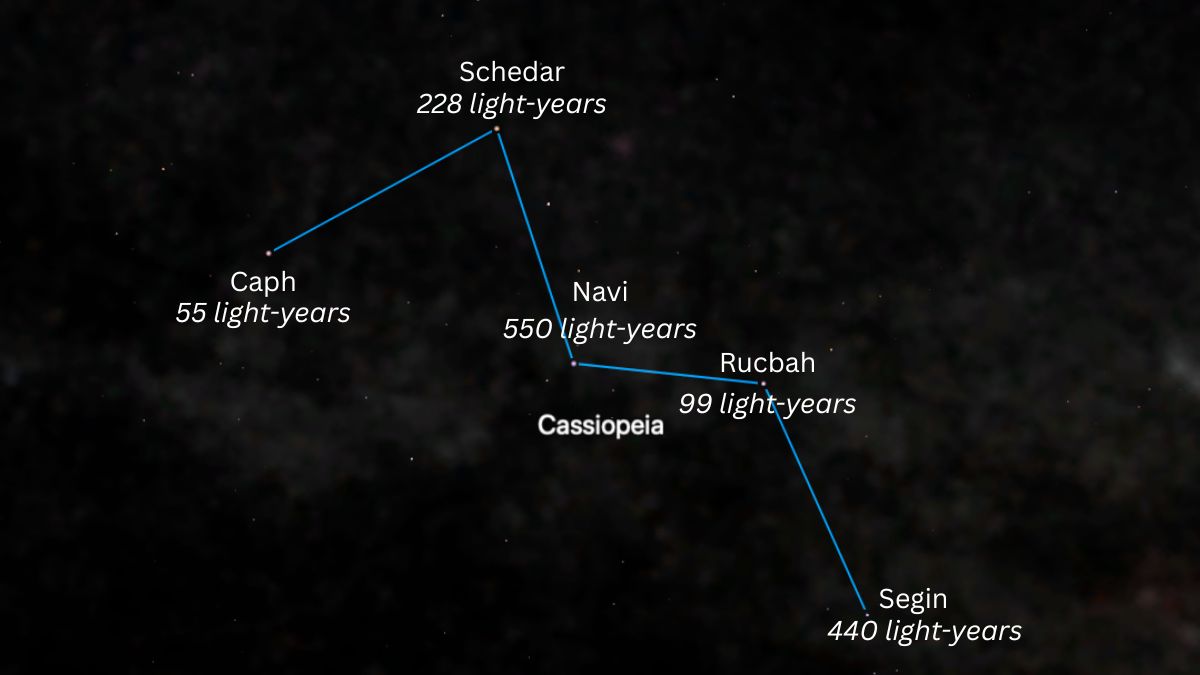
Late November is an excellent time to reacquaint yourself with Cassiopeia from anywhere in the Northern Hemisphere. Look high in the northern sky during the evening for its five prominent stars — Caph, Schedar, Navi, Ruchbah and Segin. Depending on exactly when you look, it can look like a W, E, M or a 3.
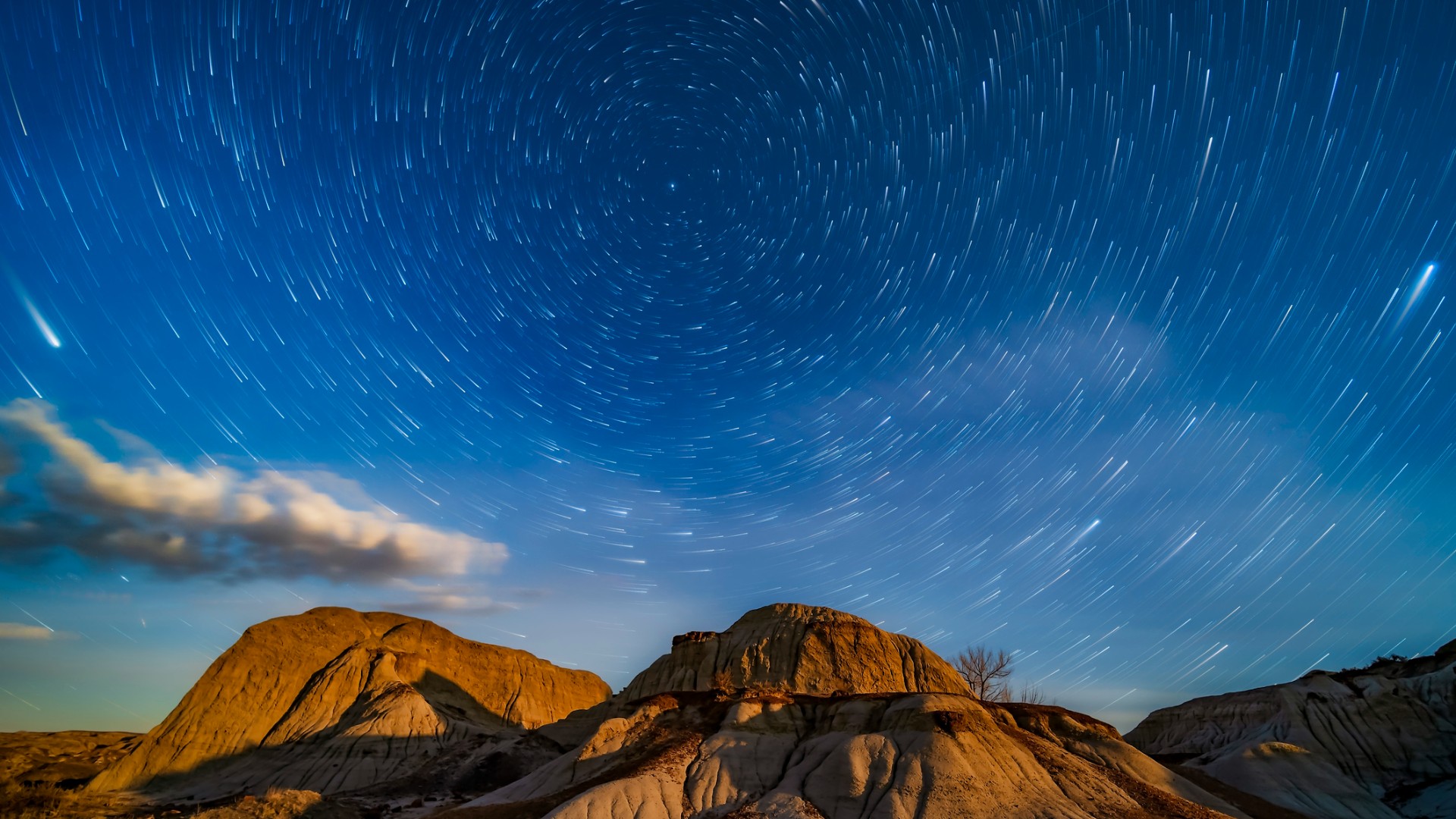
This is because Cassiopeia is circumpolar. Rather than rising in the east and eventually setting in the west like many familiar constellations, it circles the north celestial pole — a position currently held by Polaris, the North Star. From sufficiently northerly latitudes, its main stars never disappear below the horizon.
This gives us a simple observing experiment. Find Cassiopeia in the early evening and remember its orientation relative to the horizon. Go back several hours later and look again. The constellation has moved around Polaris, and its shape has changed. The stars haven’t changed their arrangement — Earth has simply rotated from west to east. We all know this logically, but watching the familiar pattern of Cassiopeia’s stars apparently tip over during a single night makes Earth’s rotation a lot less abstract.
How and when I’m watching it
I’m going to observe Cassiopeia twice on the same evening this week, which is about as complicated as the experiment needs to get. The first time will be shortly after darkness falls. I’ll find the W, note which way it seems to be pointing and use something fixed — a rooftop, tree or chimney — to give myself a rough reference for its position. I’ll return to my backyard before bed, and see where the pattern has shifted. Cassiopeia’s main stars are bright enough to survive urban and suburban light pollution, so you don’t need a particularly dark sky or a telescope.
While I’m gazing at Cassiopeia, I’ll try to see the stars as they really are, and not just how they appear to us. Check out the distances of its stars from the sun:
- Caph: 55 light-years
- Schedar: 228 light-years
- Navi: 550 light-years
- Ruchbah: 99 light-years
- Segin: 440 light-years
Only Caph and Ruchbah are within 100 light-years — the sun’s local interstellar neighborhood. Does that destroy the very concept of Cassiopeia as a group of related stars? Cassiopeia, like all constellations, is a mirage, with a capital M.
There’s another reason I love Cassiopeia. Proxima Centauri, the closest star to our sun, lies just 4.24 light-years away. Travel there and look back towards our solar system, and our sun would appear as an extra star in Cassiopeia — effectively giving the constellation a sixth bright point. From a certain perspective, we are all Cassiopeians.
Stargazer’s corner: Nov. 27-Dec. 4, 2026
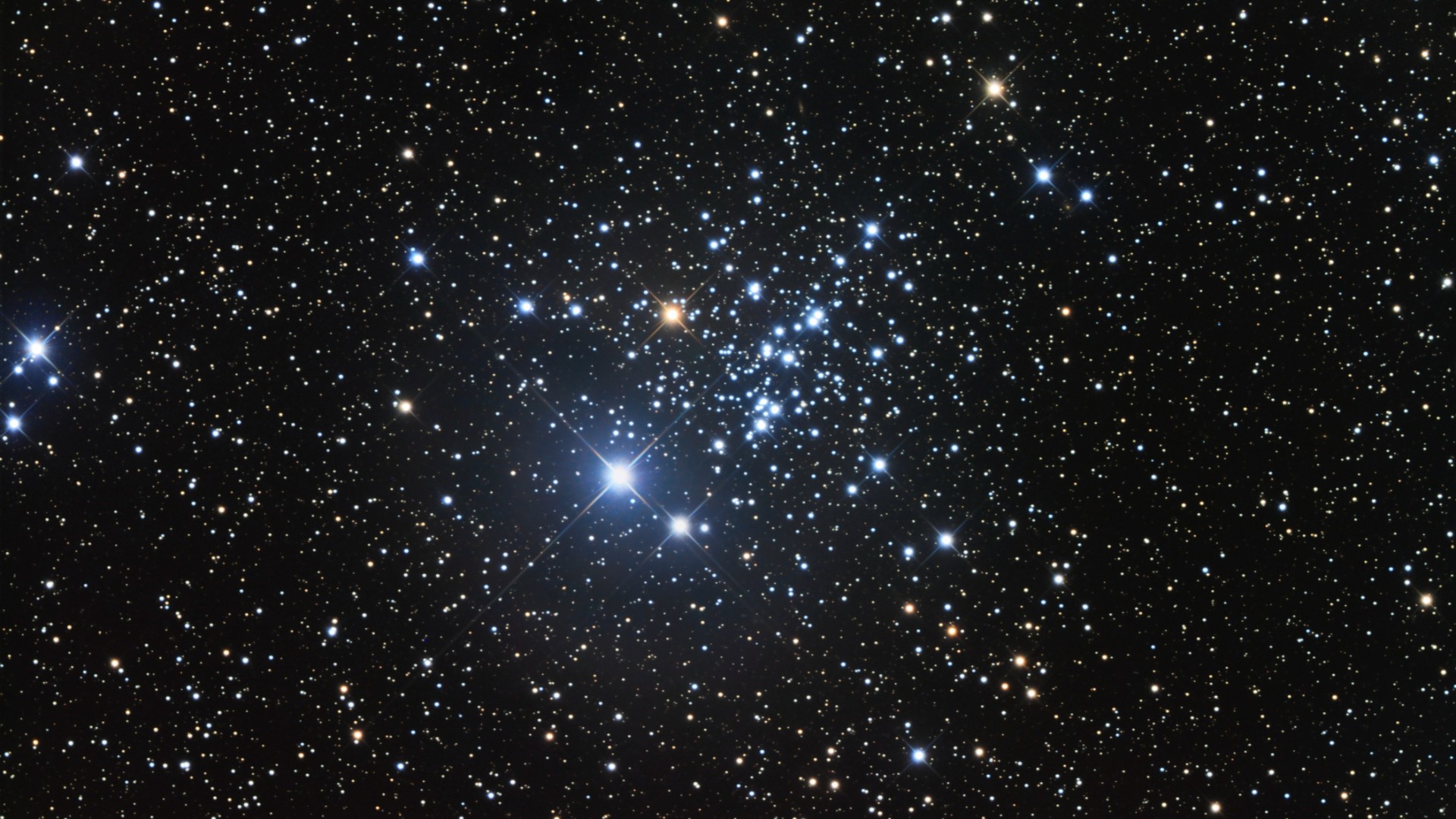
The last few evenings of November bring back darker early-night skies as the moon wanes from full earlier in the week and rises progressively later. It will rise in the middle of the night as it reaches its last-quarter phase on Dec. 1. It’s an ideal time to sweep a pair of binoculars across the rich star fields around Cassiopeia and Perseus. On the boundary between the two constellations is the Double Cluster (NGC 869 and NGC 884), one of the finest binocular sights in the entire northern sky. These two dense concentrations of young stars sit side by side against the richer background of the Milky Way. Under a dark sky, you can see it with the naked eye. M52, NGC 457 (the Owl Cluster) and NGC 663 are other clusters also worth seeking out in Cassiopeia.
Conjunction of the week: Moon, Jupiter, Mars and Regulus
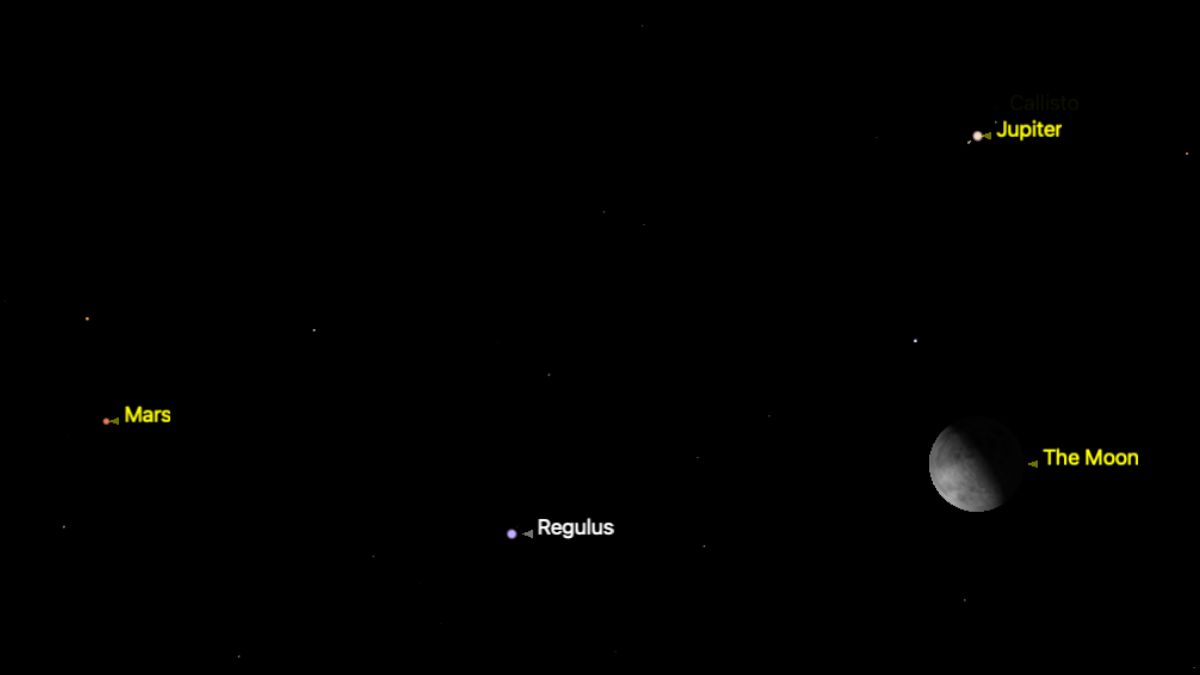
Get outside about 45 minutes before sunrise on Monday, Nov. 30, and look high in the southern sky for a fitting month-ending finale. A 61%-lit waning gibbous moon will appear alongside brilliant Jupiter, reddish Mars and Regulus, the brightest star in Leo. Together, the four objects will trace a striking crescent spanning just over five degrees of sky — roughly the width of three fingers held at arm’s length. It’s a much tighter version of a similar arrangement visible on Nov. 2, with Jupiter by far the brightest point and the contrasting colors of Mars and blue-white Regulus adding to the spectacle. No equipment will be needed, though binoculars will help you get a close-up of this rather unusual conjunction.