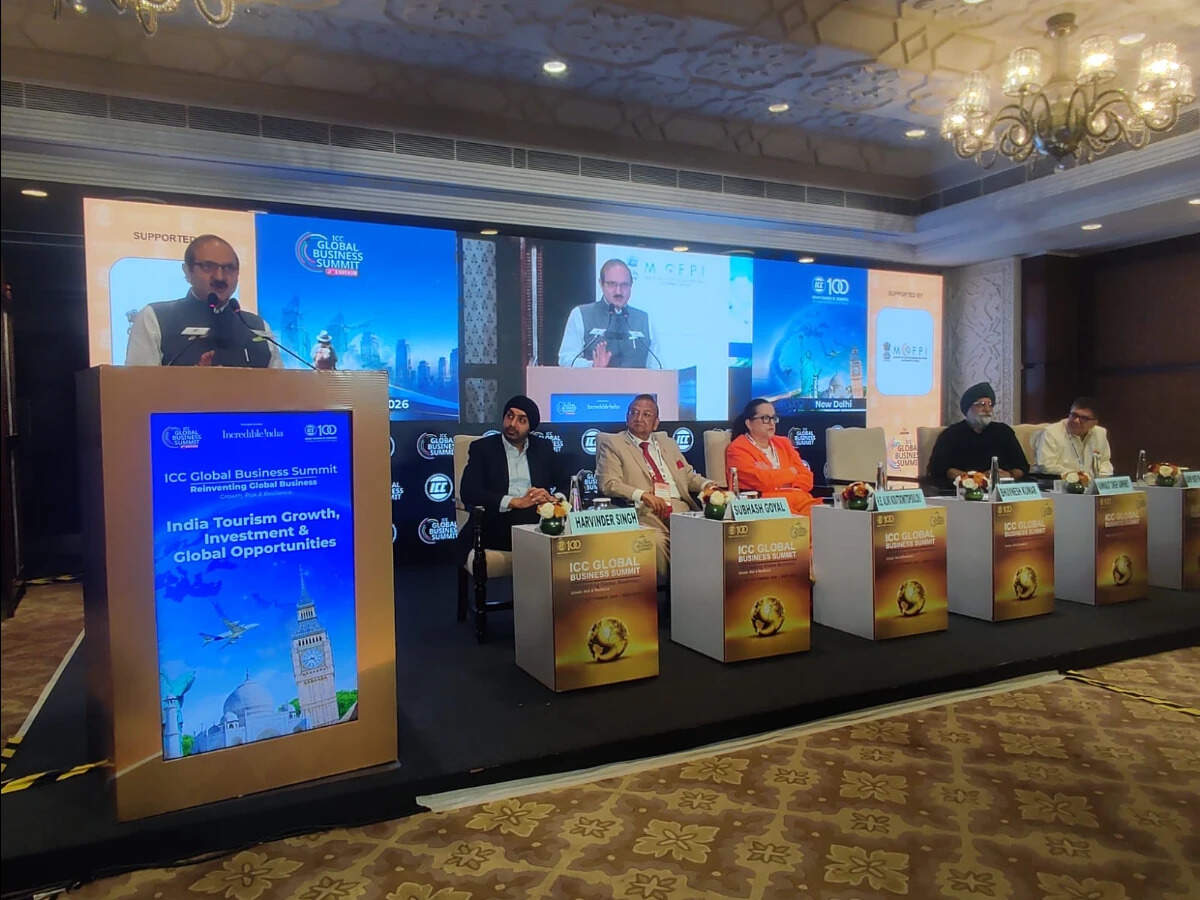
India’s tourism strategy needs to move beyond increasing the sheer volume of domestic travel and focus instead on distributing tourist demand to lesser-known destinations, Tourism Secretary Bhuvnesh Kumar said, as domestic tourist visits reached 429 crore last year.Speaking at the India Tourism Growth, Investment and Global Opportunities session at the ICC Global Business Summit 2026 in New Delhi on Saturday, Kumar said the next phase of India’s tourism growth would depend on the country’s ability to offer experiences that can compete with international destinations while taking pressure off established tourism hotspots. The session was part of the two-day ICC Global Business Summit being held on September 18-19.“We don’t really need more domestic tourism. We need distributed demand,” Kumar said, adding that the Ministry of Tourism‘s Dekho Apna Desh 2.0 initiative is being designed to direct travellers towards destinations that currently receive less visitor traffic.Among the destinations he cited were Turtuk in Ladakh, Gurez and Doodhpathri in Jammu and Kashmir and Varkala in Kerala.The shift comes against the backdrop of a substantial expansion in domestic travel. According to Kumar, India recorded 429 crore domestic tourist visits last year, making domestic travel the dominant component of the country’s tourism economy.Rather than seeking to simply add to those numbers, the Ministry is looking at how existing demand can be spread across a larger geographical footprint. The approach could help reduce pressure on overcrowded destinations while creating new opportunities for hospitality, transport, food and experience providers in emerging tourism markets.The Ministry’s existing Dekho Apna Desh initiative was launched in 2020 to promote domestic tourism and Indian destinations through digital platforms, webinars, roadshows, familiarisation trips and other promotional activities.
Focus shifts towards experience quality
Kumar also flagged a more fundamental challenge for India’s tourism industry: the need to ensure that domestic and international travellers have access to experiences comparable with those available globally.India, he said, has moved from being a net positive to a net negative on travel foreign exchange. According to the Secretary, until around 2021, foreign exchange earnings from travel exceeded Indian spending overseas, whereas the position has since reversed.”Till about 2021, we used to be net foreign exchange positive on travel, and now we are net foreign exchange negative. That means Indians are spending more abroad than the foreigners coming and spending in India. The industry needs to be ready for that and offer tourism experiences which are at par with the best in the world,” Kumar said.The challenge, therefore, is not only to attract more visitors but to improve the quality, range and competitiveness of experiences available within India.Kumar pointed to the expansion of hotel supply beyond established metropolitan markets as an indication that the investment landscape is already changing. He said one hotel group operating around 365 hotels had informed him that it plans to add another 300 properties over the next three years.He added that hospitality growth was increasingly reaching Tier-II and Tier-III cities, where stronger domestic demand is helping reduce some of the risks traditionally associated with developing hotels outside established tourism circuits.
Tourism goes digital
Digital distribution is emerging as another component of the government’s effort to broaden tourism demand.Kumar said the Ministry had initially piloted the Open Network for Digital Commerce (ONDC) in Varanasi with around 180 tourism products. The exercise has since expanded, with around 23,000 tourism products and experiences identified across the country for potential integration.The Ministry is also working towards a single customised travel pass, which Kumar said would further simplify the process of discovering and accessing tourism experiences.The emphasis on digital visibility was echoed by Harvinder Singh, Director, India Knowledge Center and Head, Middle East and India, United Airlines, who said travellers were increasingly planning around experiences rather than simply choosing destinations.”We are moving from destination to experience, and I am talking about the end-to-end experience. It is not only about the Taj Mahal or Jaipur or Agra today,” Singh said.He also pointed to the importance of digital discoverability for emerging destinations, saying that destinations that are not sufficiently visible online risk being overlooked by travellers.”The real estate on the digital platform is equally important as it is on the ground,” he said.
Visa reforms target inbound travel
Alongside domestic tourism, Kumar highlighted changes aimed at making India more accessible to international visitors.He said the number of visa categories has been reduced from 22 to nine, while the validity of the medical value visa has been extended to one year from 60 days. India’s e-visa facility now covers 171 countries, according to the Secretary.The reforms come as India seeks to strengthen its international tourism competitiveness and increase foreign visitor spending, particularly given the foreign-exchange imbalance highlighted by Kumar.
Greece sees connectivity unlock existing demand
The importance of connectivity in converting latent demand into actual travel was highlighted by Aliki Koutsomitopoulou, Ambassador of Greece to India.She said the number of Indian nationals travelling to Greece increased from 21,630 in 2022 to 29,523 in 2023 and 37,150 in 2024, based on Ministry of Tourism data. The growth, she said, amounted to almost 72% over the two-year period.”The direct flights did not create Indian interest in Greece. The demand was already there. Connectivity can now unlock it,” she said.Direct scheduled flights between India and Greece began in January 2026.Koutsomitopoulou also highlighted Greece’s new special spatial framework for tourism, introduced in August 2026, which is intended to guide tourism investment and address destination capacity.The two countries are also working towards updating their tourism cooperation agreement, with the existing agreement dating back to 1998. Rhodes is scheduled to host the 40th anniversary convention of the Travel Agents Federation of India from October 4-7, with more than 400 Indian travel professionals expected to attend.
From volume to value
The discussions at the session point towards a broader change in India’s tourism priorities. With domestic travel already operating at enormous scale, the focus is increasingly shifting towards distributing visitors geographically, creating bookable experiences, improving digital visibility, strengthening international accessibility and ensuring that tourism infrastructure keeps pace with demand.For the Ministry, Dekho Apna Desh 2.0 could therefore represent a shift in emphasis—from simply encouraging Indians to travel within the country to influencing where they travel and how the economic benefits of that travel are distributed.That approach also aligns with the government’s broader objective of using tourism to generate investment and employment beyond established tourism centres. The challenge, as the Secretary’s comments suggest, will be converting lesser-known destinations into destinations that are not only attractive, but also visible, accessible, bookable and capable of delivering experiences that compete with international alternatives.