Yearlong Mars habitat test is complete
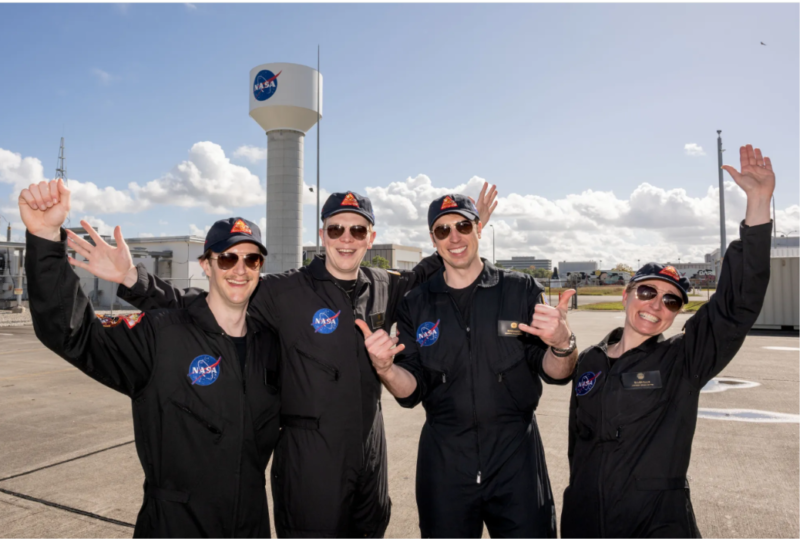
On October 19, 2025, four crew members entered a simulated Mars habitat that NASA calls the Crew Health and Performance Exploration Analog (CHAPEA). And after 378 days, the four crew members — Ross Elder, commander; Ellen Ellis, medical officer; Matthew Montgomery, science officer; and James Spicer, flight engineer — emerged from the 3D printed habitat in Houston on October 31, 2026.
The goal was to learn how a crew could live in isolation and face some of the challenges of a Mars mission. The crew had to grow their own crops, maintain their health and work together, including some simulated Marswalks.
Part of the test was to have delayed communication with “Earth”. These delays ranged from 26 to 44 minutes. Messages back and forth from Mars won’t be instantaneous, so it was important for NASA to learn how people can cope when they can’t immediately ask for advice.
Early takeaways from the experiment
The crew members said that while future Mars astronauts will need to be skilled at fixing things themselves, the real challenge will be the psychological ones. They said the inside of the habitat was unusually quiet. They also had limited opportunities for personal time. The work-rest-personal life balance could be a challenge on Mars.
For the next two weeks, the crew will undergo post-mission evaluations and debriefing.
Michael Stenger, chief scientist for NASA’s Human Research Program, said:
This mission has been incredibly valuable in starting to teach us how to understand requirements for year-long missions, including medical and psychological care, via communication delays. When combining this Mars-realistic mission analog with a suite of physiological, psychological, and performance measures in a rigorously controlled environment, we’ll be able to translate the knowledge from these experiences to Moon Base and beyond.
You can watch a replay of their exit from the habitat here.
The Mars habitat simulation
Back in 2023, NASA unveiled its simulation of a Mars habitat. This has been the second of three planned habitat simulations. The habitat is at Johnson Space Center in Houston.
During the past year, the volunteers have tested out the technology, even as they themselves are tested.
The Mars-surface simulation is part of NASA’s program CHAPEA. It’s an experiment to test human preparedness for visiting the red planet.
Currently, the Artemis mission is working on returning humans to the moon. And NASA plans to use that technology to eventually send humans a step further … to Mars. NASA’s stated goal for the Artemis missions is to:
… establish a sustainable presence on the moon to prepare for human missions to Mars.
But are humans ready to go to Mars?

Mars habitat simulation is a test
The four volunteers are not astronauts. But they are trained to simulate situations that might occur on Mars, such as habitat maintenance, robotic operations and ‘Marswalks’. Some of the ‘Marswalks’ — or spacewalks on Mars — involved geology, building and exploration.
Additionally, the crew also faced realistic stressful situations, which included resource limitations and equipment failure. For example, they had to manage with a limited amount of water as they grew their own vegetables and tackled personal hygiene.
In addition, the volunteers had to endure isolation and confinement during their year in CHAPEA. Meanwhile, scientists monitored their mental health and the social dynamics of the foursome.
Habitat construction
In the video below, you can see the giant 3D printer as it assembles the habitat.
You deserve a daily dose of good news. For the latest in science and the night sky, subscribe to EarthSky’s free daily newsletter.
Bottom line: On October 31, 2026, four participants in NASA’s Mars habitat simulation emerged after one year of testing and training for what astronauts might encounter when they someday visit Mars.
Read more: Is the Mars Grand Canyon still tectonically active?
Read more: Curiosity rover insights after 5000+ sols on Mars