The Universe as we know it is comprised of three “things”: baryonic matter (planets, stars, galaxies, us), dark matter (still unexplained) and dark energy (really, really still unexplained). Of the three, dark energy remains the most challenging. It’s “something” that’s driving the acceleration of the expanding Universe but that’s all we know about it. We can’t see it, or even put a description to it, other than “it’s mysterious”.
This cosmic component accounts for about 70 percent of the known Universe’s energy budget. Physicists have spent a lot of time trying to explain it, often invoking some hitherto-unknown fields, or exotic physical particles, or some kind of “cosmological constant” that is the same everywhere in space and time. Despite these and other attempts at explaining dark energy, physicists still don’t know exactly what it is. However, there’s hope that an explanation will come in our lifetimes. A team of scientists at Canada’s University of British Columbia and the University of Sheffield (in England) have come up with a possible model that provides an explanation. They think dark matter may be a product of the same physics that governs the strength of the atomic nucleus. If that’s true, then they could use the standard model of particle physics to understand this mysterious thing that is pushing the Universe apart.
Dark energy has many descriptions, which reflects our incomplete understanding of it. It could be a negative pressure that pushes space outward, although there’s no proof of that. It could be vacuum energy, which is an idea that there’s a background of energy that permeates all of the Universe. It’s also been called “quintessence”, which is a sort of imaginary “fluid” that fills space. Or it could be a combo of dark matter and dark energy, both yet unexplained. The wildest idea is that dark energy could be a wrinkle in the fabric of space-time, or even something leaking from another universe. All those explanations are fairly wild, and oftentimes in science, the simplest is the best explanation. That’s where the work in Canada and England is coming in handy, if particle physics can provide insight.
Searching for a Quantum of Understanding
According to lead scientist Ariel Zhitnitsky of UBC, using particle physics means we don’t need exotic explanations for dark energy. “Our theoretical framework suggests no new particles may be required at all,” said Zhitnitsky, who developed the theoretical ideas explained by the team. “The characteristic energy scale predicted from the QCD vacuum and gravity comes out close to the observed dark-energy scale today without having to introduce an ad hoc new field nor new parameter.”
What Zhitnitsky and others are talking about is a theory called quantum chromodynamics (QCD). It focuses on the strong nuclear force that holds quarks inside the protons and neutrons that make up atoms. QCD describes the actions of the strong force. Those actions could be affecting space, and in particular what it contains.
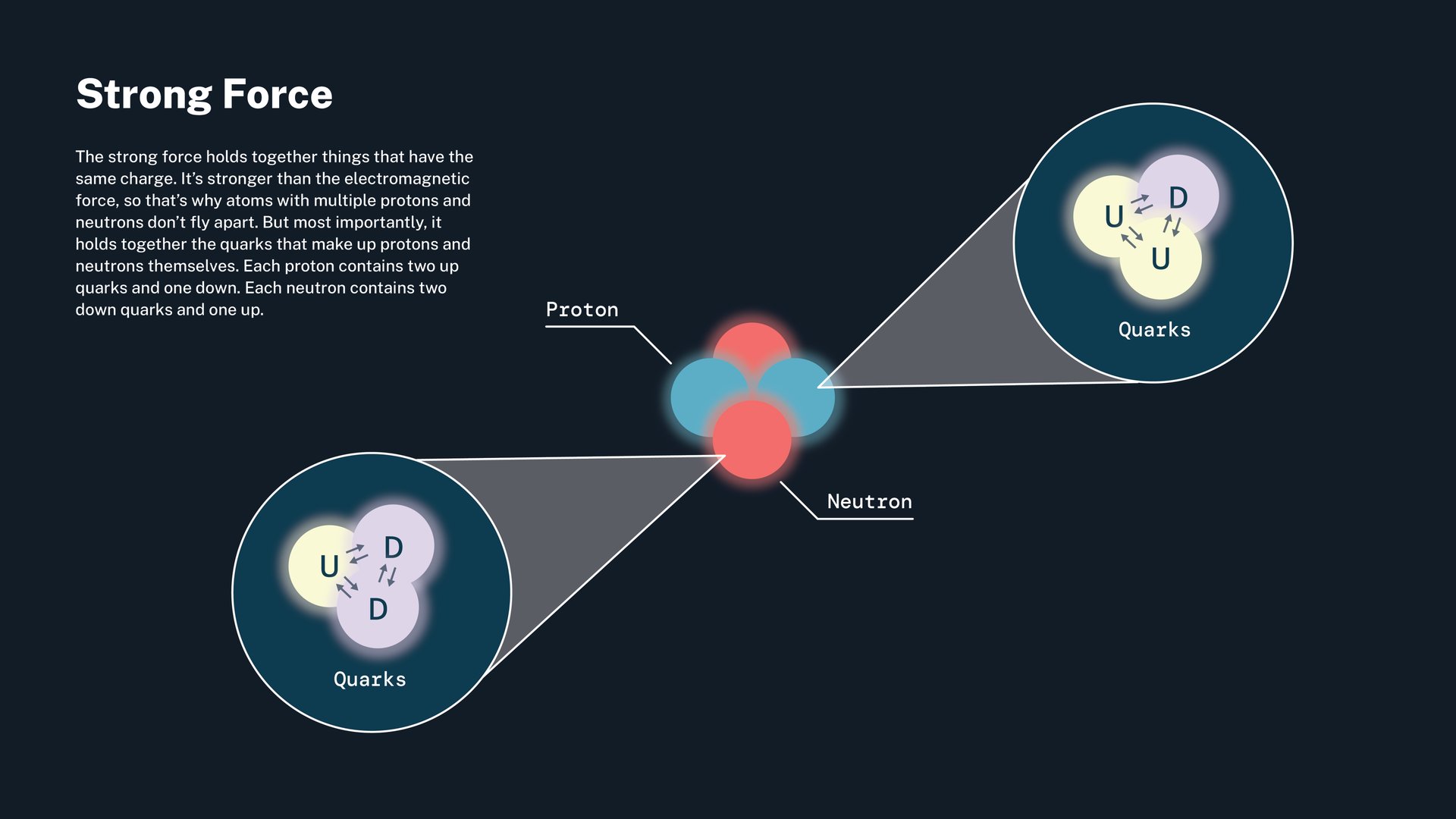
A NASA illustration of the strong force at work in an atomic nucleus. Credit: NASA
Space is never empty. Rather, it’s filled with subatomic fields and something called quantum energy. That’s energy that exists in individual packets called “quanta”. This creates a “quantum vacuum” with properties that can affect space over large distances. Now, add in the fact that the Universe is expanding, and that has implications that need further explanation. The team, led by scientist Dong Ha Lee, proposed the following: as the Universe expands, the subatomic structure in the quantum vacuum responds differently as time goes by. That response generates a small energy shift that is just enough to drive the acceleration of universal expansion. The team points out that you don’t need new particles or other exotic things for this: the current particles are just fine, Lee suggested. “The idea that the quantum vacuum as described by QCD could have the right properties to account for the accelerated expansion of the universe is very intriguing,” said Lee.
Testing a New Idea Using Standard Physics
So, if this idea holds up, it means that dark energy could have a connection to the strong nuclear force. Scientists could create models to test this using currently available physics models. The big test would be to compare it to cosmological data, according to Lee. ”Our analysis shows that such a model can reproduce the evolving dark energy behaviour suggested by current observations. This motivates further theoretical work to better understand how the QCD vacuum responds to cosmic expansion and to develop predictions that can be tested with future observations.”
When tested against real astronomical data including light from distant supernovae and leftover radiation from the early Universe, the team found that their model matched observations just as well as standard cosmological models. In addition, it offers a possible way to explain what is causing dark energy. The next step for the team is to keep refining their model and calculations in order to build as robust a model as possible. By that time, observations and data from the next generations of telescopes, such as the Nancy Grace Roman telescope, could prove very useful in testing ideas about the true nature of dark energy and its effects on the expanding Universe over time.
For More Information
Could Standard Physics Explain the Mysterious Energy Driving the Universe Apart?