- Nagaland is an important hotspot of freshwater biodiversity in the Eastern Himalaya and Indo-Myanmar region.
- A new catfish species has been named after the Likimro river in Nagaland where the specimens were found.
- The fish has physical adaptations to survive in the fast-flowing, torrential waters of the river.
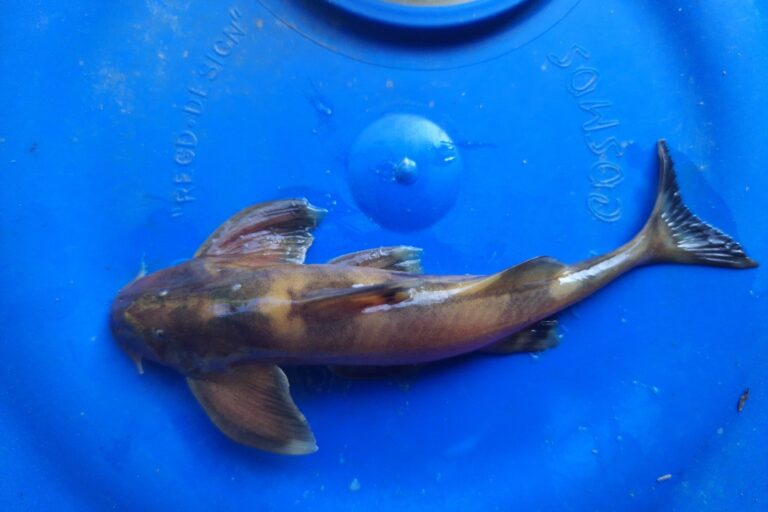
A new catfish species, Pseudecheneis likimroensis, has been described from India’s north-eastern state of Nagaland. The species, named after the fast-flowing Likimro river, from which specimens have been collected so far, was described in the Journal of Ichthyology.
The discovery took place unexpectedly when a research team was in the region to survey fish fauna in Nagaland’s Kiphire district, said Limatemjen, co-author of the paper on the new species. Kiphire is a remote district, situated in the eastern part of the state and lies along the India-Myanmar border.
“First we had to travel from Kohima to Kiphire, covering a distance of around 100 km. However, the journey takes much longer due to difficult road conditions,” Limatemjen, a professor of Zoology and Dean of Sciences at Kohima Science College, told Mongabay-India. After reaching Kiphire, the team took another four-hour journey to Likimro river where they walked yet another hour to reach the designated sampling site. Characteristic of mountain streams, the sampling site is torrential in nature and is surrounded by steep valleys.
Around five specimens of Pseudecheneis likimroensis were collected by the team during the survey in October 2024. Although initially surprised by the unusual catch, found at an elevation of 446 m above sea level, it was only after bringing the specimens to the laboratory and running detailed examinations did the team realise they had an undescribed species at hand.
Catfish adapted to torrential waters
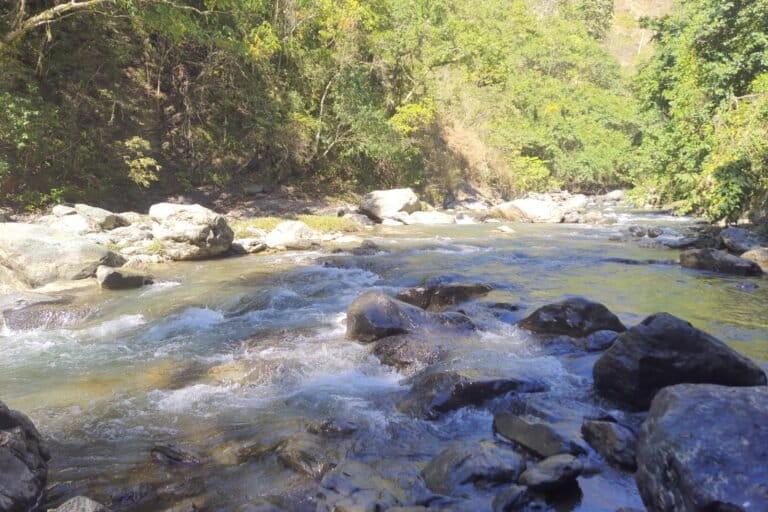
Likimro river, where the specimens were found, is known for its fast-flowing and pristine water with high presence of boulders and rocks. The new catfish has adaptations which help it thrive in these waters.
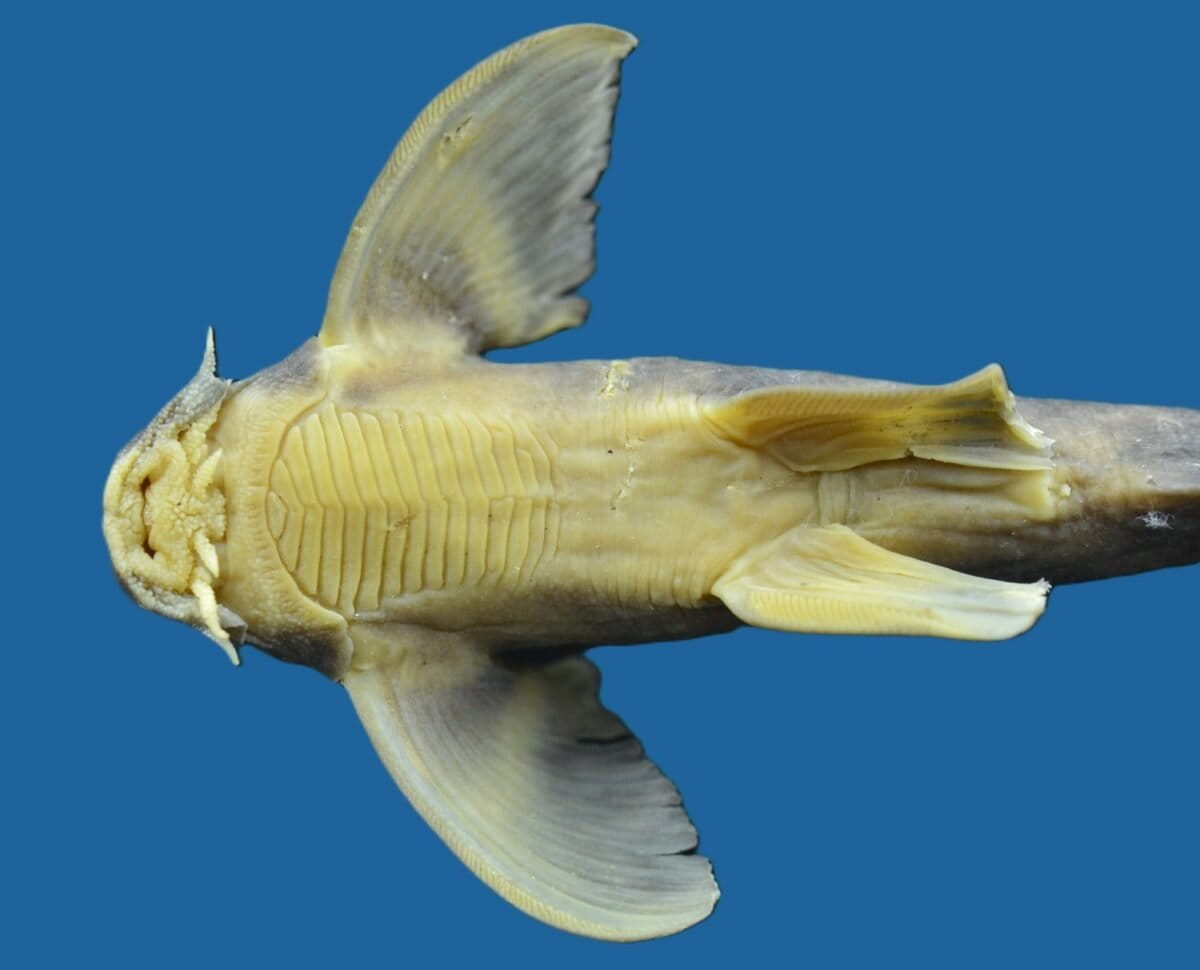
“These fish exhibit remarkable adaptations, such as dorso-ventrally flattened bodies and specialised adhesive structures, enabling them to thrive in torrential environments,” explains Laishram Kosygin Singh, ichthyologist at Zoological Survey of India and co-author of the paper. The specialised adhesive organs with ridges, separated by grooves, are all adaptations that allow the fish to cling to the rocky substrate of torrential rivers in hilly regions. The species is carnivorous in nature as it feeds on insects, larvae and other organisms found attached to rocks. According to the paper, the holotype (main reference specimen) measured around 11.53 cm, with the largest specimen recorded at around 13.19 cm.
“Pseudecheneis (the genus of catfish) are rheophilic catfishes adapted to life in swiftly flowing hill streams,” says Shekumcha Y., co-author and research scholar, whose initial fieldwork led to the discovery of the fish. “We collected the specimens using traditional methods wherein we employed cast nets and the process also involved local fishermen,” she says.
On the nature of the habitat where the catfish was found she states, “Likimro river is a tributary of Tizu–Chindwin system in the Indo-Myanmar biodiversity hotspot which already contains several endemic fishes.” Species endemism refers to a phenomenon in which a particular species is native to and only found in particular geographical areas.
A biodiversity hotspot protected by community
Likimro river originates around Nagaland’s highest peak, Mount Saramati, and is a tributary of the Tizu river, flowing along the eastern Kiphire district. Tizu river stands apart from other river systems in northeastern India which drain into the Brahmaputra river as it actually flows into Myanmar and joins the Chindwin river which in turn ultimately merges into the Irrawaddy river system.
According to Kosygin Singh, the Chindwin–Irrawaddy drainage system, is increasingly recognised as one of the most significant hotspots of freshwater endemism in South and Southeast Asia. “This recognition stems from its complex geology, long-term isolation from neighbouring river systems like the Brahmaputra, Kaladan, Salwin, and Mekong Rivers, diverse habitats, and recent intensive taxonomic research,” he adds. The isolation of the drainage system can be attributed to the tectonic uplift related to the Indo-Burman Ranges and the process of collision of tectonic plates in the case of Himalayas, which has repeatedly changed river courses and created numerous streams. Such changes, he said, in turn created barriers that facilitated speciation, thereby giving rise to many endemic hillstream species.
Pranay Punj Pankaj, an associate professor of Zoology at Nagaland University, who was not associated with the study, states that environmental conditions can lead to visible variations. “Morphological features are influenced by factors such as oxygen content of the water and its temperature, sunlight, river depth and the overall habitat.” Pankaj has sampled freshwater rivers such as Chathe, Dikhu, Tsurang, Milak to name a few in Nagaland to check for pathological symptoms in its native fish populations. He said, “We conducted tests at many sampling sites and although pollution levels may sometimes differ, say if the site is close to an urban area or where there is effluents discharge, overall we found the water quality in the rivers to be very good.”
However, he warns that things might be changing for the worse. “We did a survey on the Doyang river where old data suggested the presence of around 60 species but the team could only report around forty,” says Pankaj. He also states that the degradation and destruction of fish breeding zones is also a major factor. “Fish often spawn in stretches of river which are shallow, unfortunately making such areas quite accessible. Fishermen now also complain of reduced catch,” he says.
Shekumcha states that there is yet no information on the breeding grounds of Pseudecheneis likimroensis. “Since it’s currently found only in the Likimro river, there might be some ecological pressure. We are not sure.” she adds.
Stressors such as dynamite fishing, use of chemicals and poisons, river modification projects and coal mining, just to name a few, have added to the woes of Nagaland’s native fish species. On the culinary side, egg bearing females are also highly sought for consumption as they are considered a delicacy. “If we eat such fishes, all we are doing is destroying potential mothers who are needed to sustain populations. Naturally, the next generation will be under threat,” adds Pankaj.
Limatemjen says that researchers often keep the location of spawning grounds discrete. “If people were to know the exact location, they would simply hunt. We just advise villagers to refrain from fishing during a broad period of time,” he says. According to him, local residents of the village have imposed their own strict rules at the site where Pseudecheneis likimroensis was collected from. “While the sampling site does not come under Community Conserved Areas (CCA), locals have barred destructive fishing practices,” he says.
Aniruddh Soni, Associate Fellow at The Energy and Resources Institute (TERI), reflects on how CCAs are helping preserve the region’s flora and fauna. “CCAs are forest lands, wetlands, rivers and other ecosystems which are managed and even voluntarily protected by local village communities under customary law.” In Nagaland, customary law refers to the traditional practices and institutions which are followed by the state’s indigenous tribes. “It is quite natural that the locals are often the most knowledgeable about local species and can actually play an active role in managing the ecosystem,” he says. “Sometimes if freshwater river systems come under CCA, then breeding grounds too can find a safe haven.”. However, according to him, rapid urbanisation and development have also put pressures on the fragile CCAs. Emphasising Nagaland’s immense aquatic biodiversity, Shekumcha states, “The discovery of Pseudecheneis likimroensis adds to the known aquatic biodiversity and further strengthens the growing scientific recognition of Nagaland as an important hotspot of freshwater biodiversity in the Eastern Himalaya and Indo-Myanmar region.”
Nagaland’s freshwater biodiversity blind spot is also evident by the fact that the team believes they may have more species on the cusp of discovery. “Our team already has three more fish species which are yet to be formally described or their details published,” says Limatemjen. He cites the slow and arduous process involved in confirming a new species, which entails comparative studies, analysis of the tiniest of anatomical differences, conducting DNA analysis just to name a few steps. “We do not even have proper documentation of these remote rivers, let alone the immense biodiversity in them,” says Pankaj, adding that it is also increasingly difficult to find the required number of specimens to study.
Banner image: Lateral view of a specimen of Pseudecheneis likimroensis. Image courtesy of Zoological Survey of India.