
- A new study finds that mean annual temperature is the most important climatic factor influencing the distribution of the elusive ibisbill within the Kashmir and Ladakh Himalayas.
- Future climate projections indicate an expansion in the ibisbill’s habitat range, particularly along mid-elevation river corridors.
- However, human activities such as boulder mining, plastic and garbage pollution, also add pressures on the ibisbill’s habitat.
The ibisbill (Ibidorhyncha struthersii), an elusive bird confined to the boulder-strewn mountain rivers of the Himalayas, has long remained one of the region’s least-studied species. Researchers have now produced the first detailed climate-based assessment of the bird in North-Western Himalayas, identifying where its suitable climatic conditions exist today and how they may shift under future warming.
Listed as least concern in the IUCN red list, the ibisbill occurs across the Himalayas and the Tibetan Plateau. However, it remains one of the most elusive riverine birds in the Himalayan region, restricted to specific habitats and with no conclusive population estimate from India, says Ankita Sinha, a wildlife biologist and researcher at Senckenberg Biodiversity and Climate Research Center, Frankfurt. “Because of their limited sightings and ranges restricted to remote uninhabited areas, knowledge on their ecology and behaviour is limited,” she says.

These specialist birds are restricted to fast-flowing high-altitude rivers, particularly ones with gravel bars and ones that are braided. Their long, curved bills are adapted to feeding between stones and under gravel, where they mainly feed on aquatic insects, larvae and other invertebrates. They also nest directly on gravel bars, making them highly dependent on intact river habitats.
Its habitat, particularly near the towns and valleys, is also occupied by people, shares Asad Rahmani, an ornithologist and the former director of Bombay Natural History Society. As boulders are required for building houses, roads, extensive boulder-mining takes place near the rivers, which is disturbing the bird, he adds.
The presence of human habitation also increases the number of crows, kites and dogs which are direct threats to the ibisbill’s eggs and chicks.
Temperature shapes the ibisbill’s range
Beyond anthropogenic changes, the ibisbill’s habitat is also impacted by climate change. To identify the bird’s current suitable range and project how it may change in the future across the northwestern Himalayas, the researchers at Sher-e-Kashmir University of Agricultural Sciences and Technology conducted a study. Supported by the Science and Engineering Research Board (SERB), Government of India, the researchers used a technique called species distribution modelling (SDM) where they took known locations where ibisbills have been recorded and matched those against climate data to figure out what climate conditions the bird “prefers.”
Rather than relying on just one statistical model, they used an ensemble approach running several different modelling algorithms to make the projections more reliable. They fed the models six bioclimatic variables, things like mean annual temperature, temperature seasonality, and precipitation patterns.
Published in Journal for Nature Conservation, the findings show that mean annual temperature is the most important climatic factor influencing the distribution of the ibisbill within the Kashmir and Ladakh Himalayas. “Among the predictors, mean annual temperature was the dominant driver, accounting for approximately 60% of relative importance, whereas other temperature- and precipitation-related variables contributed comparatively little to explaining the species’ distribution. Future projections indicate a net expansion in the area subject to suitable climatic conditions, particularly along mid-elevation river corridors,” the research shows.
Rohan Menzies, an ornithologist at the Nature Conservation Foundation in India, who wasn’t involved in the study says, “The study provides the climatic requirements or preferences for the ibisbill in the region; however, climate is only a single requirement.” The other conditions of the river that are impacted by human activities will also determine the suitability of an area for the species to occupy, he clarifies adding that climatic suitability does not ensure habitat suitability.
Khursheed Ahmad, co-author of the study and a senior scientist at division of wildlife sciences, SKUAST- Kashmir agrees, “Suitable climate alone is not enough. As a highly specialised riverine bird, the ibisbill depends on intact braided rivers, gravel bars and natural river flow for breeding and survival.”

Returning home to disappearing rivers
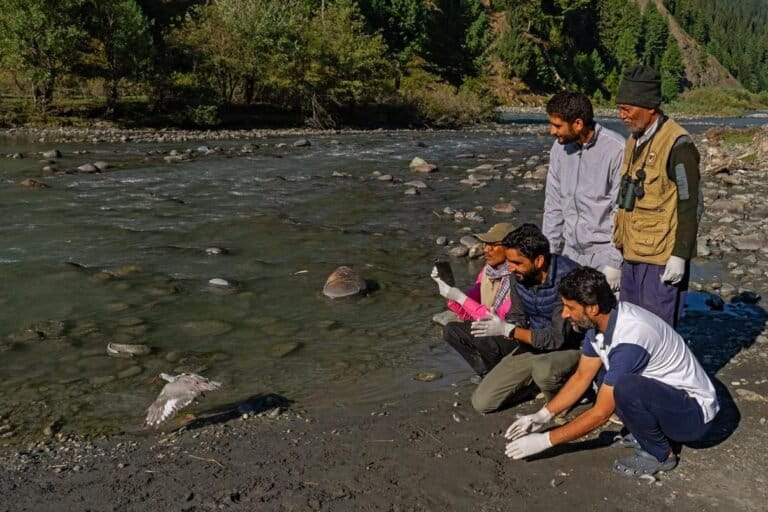
“Satellite telemetry-based studies conducted by us have provided pioneering insights into the movement ecology of the ibisbill, including its breeding patterns along elevational gradients and its remarkable nest-site fidelity,” shares Ahmad.
The ibisbill is a resident breeder in Jammu and Kashmir, particularly in the Sindh and Lidder rivers. Findings from previous studies indicate that ibisbills consistently return to the same nesting sites across successive breeding seasons.
“However, our studies have also documented severe degradation of these critical breeding habitats along the Sindh river in the Ganderbal district of Central Kashmir due to extensive sand and boulder mining,” Ahmad shares. “This poses a significant threat to the species’ reproductive success and long-term survival, underscoring the urgent need to conserve and legally protect these key nesting sites from further anthropogenic disturbance,” he adds.
According to Ahmad, the recent study’s findings also highlight that conservation efforts must focus not only on climate change but also on protecting breeding sites, maintaining healthy river habitats and preserving connectivity between river systems. “Safeguarding free-flowing Himalayan rivers and their natural geomorphology is essential for the long-term survival of this unique and little-studied species, as well as many other river-dependent species,” he says.
Rahamani also points to the increase in garbage and plastic pollution, and an increase in dog numbers. “If the situation is not changed, I am afraid, the ibisbill will disappear from the Kangan area and many parts of the Sindh river and the nallahs.”
He also pointed out that ibisbill is a monotypic species, which means it is so distinct from other birds that it is the only member of its entire taxonomic family, Ibidorhynchidae. Therefore, it is extremely important to conserve the bird.
“Because of their value as indicators of ecosystem health and as umbrella species, protecting them could benefit entire riverine ecosystems,” Sinha adds.

How Himalayan rivers are changing
Climate change is accelerating glacier melt and the early loss of seasonal frozen ground, which can increase river discharge in the short term while destabilising riverbanks, raising sediment loads and making channels shift more quickly in high-altitude Himalayan rivers.
Remote sensing studies reveal that Himalayan rivers are changing their routes faster, forming more cut-offs and new channels, becoming more geomorphically unstable. Himalayan river ecosystems are also impacted by rampant human pressures that reshape channels and riparian habitats. Studies show that dams, water diversion, agriculture, urbanisation and channel engineering are leading to loss or alteration of native riparian vegetation, narrowing active channels and pushing rivers from braided patterns toward more meandering ones.
“Those changes can concentrate erosion on banks, alter habitat structure and raise risks to nearby communities and infrastructure. In high-altitude rivers of Kashmir and Ladakh, shrinking lakes, encroached wetlands and polluted catchments reduce the landscape’s ability to buffer floods and support aquatic life,” says Sinha.
Menzies says similar pressures are evident in the eastern Himalaya, where mining and dam construction are transforming river systems.
“These activities change the areas surrounding the rivers as well, which has an even broader impact on the riverscape. Habitat-specialist river birds tend to avoid stretches of river that have been altered drastically. Species like redstarts and forktails, which require rocks and boulders along the river to forage, occur in lower abundances where mining has occurred,” he says.

The need to study river-dependent birds
Despite Asia being home to nearly half of the world’s specialist river birds, these species remain poorly studied and are rarely included in routine river monitoring programmes. As a result, scientists still know little about their breeding, feeding, movements, population size and how they respond to environmental change — gaps that make conservation planning difficult.
“River-dependent birds have not been part of regular river monitoring studies. Filling these knowledge gaps is the first step towards conserving these specialist species,” says Sinha.
“Radio telemetry and translocations can strengthen conservation by identifying previously unknown suitable habitats and revealing new ecological insights into these specialist river birds,” he adds.
Banner image: An ibisbill tagged and fitted with satellite PTT. Image by Khursheed Ahmad.
Read more: Red-naped ibises carry antibiotic-resistant bacteria, study finds