
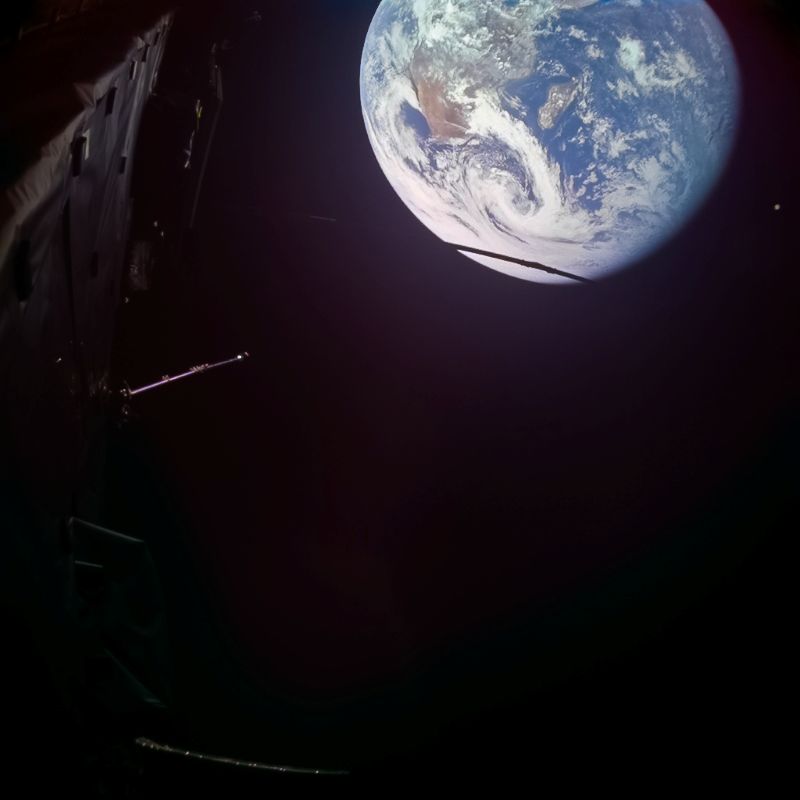
JUICE mission completes successful flyby of Earth
On Monday, September 28, 2026, the European Space Agency’s JUICE mission successfully completed a flyby of Earth. This was a gravity assist, designed to increase the spacecraft’s speed and alter its trajectory as it makes a winding trip to Jupiter. JUICE launched in 2023 and is due to arrive at Jupiter in 2031. Its job will be to explore Jupiter’s ocean-bearing moons: Europa, Ganymede and Callisto.
During the JUICE flyby, the spacecraft passed just 5,369 miles (8,640 km) above the Indian Ocean. That’s less than 70% of the diameter of Earth itself. Its closest approach was at 6:45 a.m. CDT (11:45 UTC) on September 28. And JUICE captured new images of our home planet and the moon as it passed.

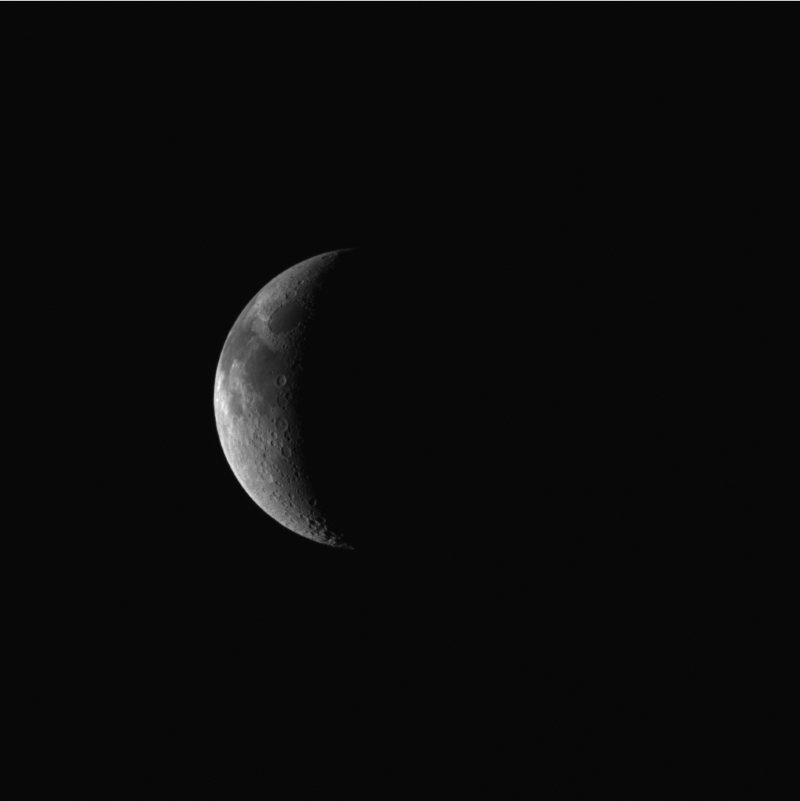
More on the Earth flyby
The point of the flyby was to help correct JUICE’s course toward Jupiter and give it a burst of speed. But at the same time, it was also an opportunity to test JUICE’s instruments. As ESA said:
The Earth flyby is a great opportunity to calibrate instruments, figure out how best to work with them in space (where they always work a little differently to on Earth!), and develop data analysis tools. But the icy moon flybys will be the real deal, and JUICE needs to be ready to collect the best possible scientific data.
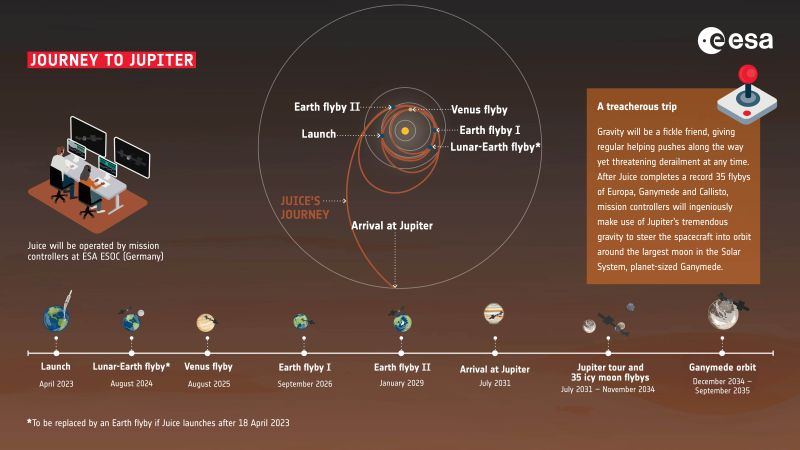
JUICE had already completed an Earth-moon flyby and a Venus flyby. This was another flyby of Earth. But it’s not done yet. It will have a another flyby of Earth in 2029, before it reaches Jupiter in 2031. Meanwhile, as JUICE speeds away from its latest encounter with us, it will take more images looking back at Earth around October 2. So stay tuned for more!
JUICE mission launched in 2023
ESA’s JUICE mission launched on April 14, 2023, after a one-day delay due to lightning at ESA’s spaceport in French Guiana. The spacecraft lifted off successfully into cloudy skies, beginning a multi-year mission to Jupiter and its icy moons.
As often happens with missions to the outer solar system, the spacecraft has to take a circuitous route to Jupiter, making multiple sweeps past the moon, Earth and Venus. Then, in 2031, it will arrive at the giant planet. At that time, it will perform 35 flybys of the Galilean moons Europa, Ganymede and Callisto, before going into orbit around the largest moon, Ganymede.

Jammed antenna
The JUICE mission’s primary antenna jammed soon after launch. But after three weeks of troubleshooting, engineers finally managed to fix the antenna. As the spacecraft traveled through deep space, JUICE mission control tried using thrusters to shake the antenna. Then they tried warming the jammed components in the sun’s rays. Finally, the team fired a mechanical device called an actuator. And that’s what made the antenna break free from its stuck position on May 12, 2023.
This RIME antenna, which stands for Radar for Icy Moons Exploration, will be used to study the structure of Jupiter’s icy moons down to a depth of 5.5 miles (9 km), when it finally reaches the gas giant in July 2031.
Earlier flybys
After its launch in 2023, JUICE’s first gravity assist flyby was the first-ever maneuver of its kind.
On August 19 and 20, 2024, JUICE swung past both the moon and then Earth. The flyby of the moon and Earth was technically a braking maneuver. It served to line JUICE up for a Venus flyby, where the successful gravity assist sped up the spacecraft, or gave it the juice, if you will.
The Venus flyby was on August 31, 2025.
After the Venus flyby, JUICE then flew by Earth on September 28, 2026. The last one will be in January 2029. Then JUICE will head out toward Jupiter, arriving in 2031.
JUICE mission goals
ESA said its goals for JUICE are to:
… make detailed observations of the giant gas planet and its three large ocean-bearing moons – Ganymede, Callisto and Europa – with a suite of remote sensing, geophysical and in situ instruments.
And, ESA said, the mission will characterize these moons as both planetary objects and possible habitats.
ESA hopes that a wider study of the Jupiter system can be used as an archetype for gas giant planets and their moons across our Milky Way galaxy.
Why JUICE will study Europa
JUICE will arrive at Jupiter in 2031. One of the moons it will observe is perhaps the most fascinating of the Jovian moons to Earthly scientists: Europa. This moon is thought to have an ocean of liquid water under its icy crust (also made of water ice). And JUICE is designed to look for the sort of chemistry on Europa that is essential to life on Earth, for example organic molecules, or molecules containing carbon, that are key to life on Earth.
JUICE also aims to understand the formation of Europa’s surface features and the composition of any non-water-ice material.
Why JUICE will study Ganymede
After a series of flybys of Jupiter and three of its large, icy moons, JUICE will eventually settle into an orbit around the largest moon, Ganymede. JUICE will orbit Ganymede down to 125 miles (200 km) for about three years. It’ll end its mission with an impact on the moon’s surface.
While at Ganymede, JUICE has many science objectives. They include:
- Characterization of the ocean layers and detection of possible subsurface water reservoirs.
- Topographical, geological and compositional mapping of the surface.
- Study of the physical properties of the icy crust.
- Characterization of the internal mass distribution, dynamics and evolution of the interior.
- Investigation of the exosphere.
- Study of Ganymede’s intrinsic magnetic field and its interactions with the Jovian magnetosphere.
Having a better understanding of this wet, cold world will also help us understand possible distant worlds around other suns, scientists say.
JUICE mocktails
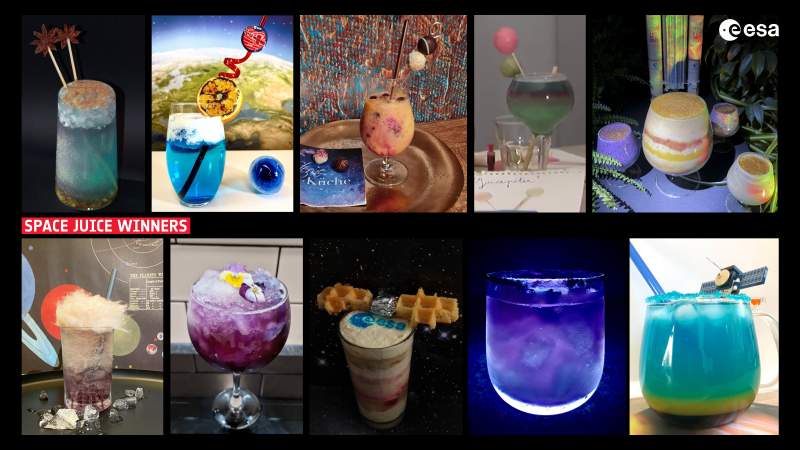
ESA had a little fun with the acronym JUICE, by holding a space juice contest. Check out these beautiful mocktails, and find the recipes here.
JUICE art, from kids
ESA also invited kids from around the world to create JUICE-inspired artwork. Read more about the contest here. The winning entry – submitted by 8-year-old Yaryna from Ukraine – is going to space! It was painted on the Ariane 5 rocket, which launched JUICE.
Bottom line: The JUICE mission made a successful flyby of Earth on September 28. See new images of Earth and the moon here. The spacecraft will reach Jupiter in 2031.
Read more: Why do Jupiter’s large moons outnumber Saturn’s?
Read more: Icy moons’ puzzling features may be due to salty ice
![Maharashtra formally recognises women farmers regardless of land ownership [Commentary]](https://imgs.mongabay.com/wp-content/uploads/sites/30/2026/09/26113827/Potato_harvest_in_Himachal_Pradesh_India_2011-768x512.jpg "Maharashtra formally recognises women farmers regardless of land ownership [Commentary]")


![India’s coking coal push needs a methane plan [Commentary]](https://imgs.mongabay.com/wp-content/uploads/sites/30/2026/09/29114008/2.jpg "India’s coking coal push needs a methane plan [Commentary]")