- A new study in Jammu and Kashmir has mapped potential risk zones for the transmission of foot-and-mouth disease in areas where livestock migration routes overlap with areas with wildlife.
- While active FMD surveillance carried out by the animal husbandry department is focused on cattle, buffaloes, sheep, and goats, wildlife is not included in the surveillance.
- Protected areas (PAs) located closer to pastoral settlements face critical risk due to enhanced probability of interspecies contact, shared grazing grounds, and environmental contamination.
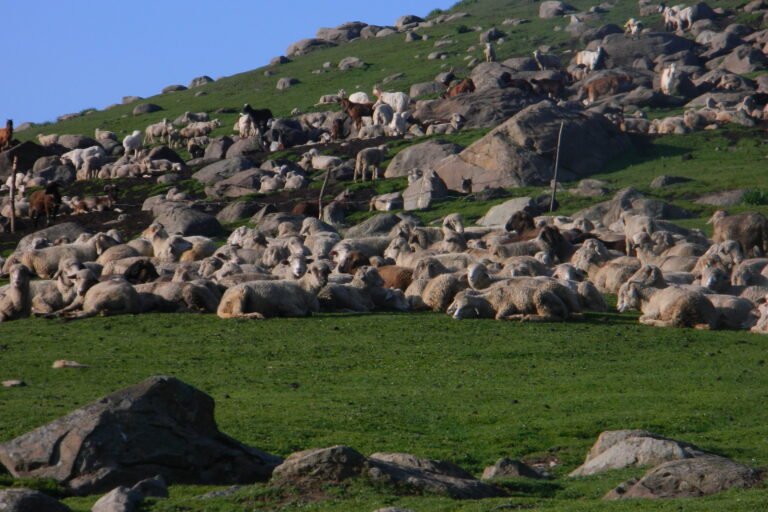
Every summer, Gujjar and Bakarwal pastoralists in Jammu and Kashmir move their livestock to the mountains in search of pastures. These routes bring the cattle closer to habitats of rare wild ungulates such as the endangered hangul (Kashmir red deer) and the markhor (wild goat). This is risky, as foot-and-mouth disease (FMD) outbreaks have been reported among livestock in the region with suspected FMD-like outbreaks occurring in July 2024 (in Kargil’s highland pastures) and May 2024 (in Bandipora and Pulwama districts). Widespread outbreaks were also recorded in 2021 across Budgam, Pulwama, and Srinagar.
The pastoral routes could create opportunities for diseases such as FMD to spread from livestock to wildlife, although transmission in these areas has not been confirmed.
A new study has mapped potential FMD risk zones in Jammu and Kashmir where livestock migration routes overlap with or lie close to protected areas. The study authors say that the findings can support veterinarians, conservationists, and policymakers in managing the deadly FMD transmission and aid in achieving One Health targets.
Where livestock routes meet wildlife habitats
Foot-and-mouth disease (FMD) is a highly contagious viral disease that affects cloven-hoofed animals, including cattle, buffaloes, sheep and goats. It is endemic among livestock in India, including Jammu and Kashmir.
“While systematic mass vaccination under the National Animal Disease Control Programme (NADCP) by Animal Husbandry Department has helped dampen large-scale epidemics in Jammu and Kashmir, seasonal movement of Gujjar and Bakarwal pastoralists with their livestock and pockets of unvaccinated or partially immunised livestock continue to sustain focal outbreaks,” explained Dr. Pervaiz Dar, an associate professor of veterinary microbiology at Sher-e-Kashmir University of Agricultural Sciences and Technology. He has worked extensively on FMD and his current research focuses on understanding host-virus interactions, viral disease dynamics and the translational development of veterinary biologics.
This cross-species transmission at the wildlife-livestock interface is an under-recognised conservation and biosecurity issue in India, he adds.

National disease monitoring frameworks have historically been livestock-centric and production-oriented, said Dar. “In mountainous, biodiverse ecosystems like the Kashmir Himalayas, free-ranging pastoral livestock share an ecosystem with endangered wild ungulates. Pathogen spillover poses not only a livestock economic and health threat but also an existential extinction risk to small, isolated wildlife populations.”
To understand where the risky areas lie, researchers at the Central University of Jammu carried out a study by mapping pastoral routes, grazing grounds, and protected areas to identify zones where pastoral livestock routes overlap with habitats of endangered wild ungulates in Jammu and Kashmir region. The pastoral communities migrate seasonally between winter pastures in Jammu, Rajouri, and Poonch districts and summer pastures in the Pir Panjal and Greater Himalayan ranges, creating recurring wildlife-livestock contact zones.
Published in the Virus Disease journal in July 2026, the study used GIS-based spatial analysis, participatory surveys with herders, and reviewed veterinary records. On the basis of distance outside the boundary of protected areas overlap with the pastoral migratory routes, three distinct zones were demarcated namely high-risk zones (up to 5 km), buffer zone 1 (5.1 km-10 km) and buffer zone 2 (10.1 km-15 km).
What the study found
The study identified 34 potential wildlife-livestock disease risk zones across 15 protected areas out of the 48 in Jammu and Kashmir. Baramulla had the highest number of identified interfaces (11), followed by Bandipora (nine), Rajouri (eight) and Ganderbal (seven), together accounting for more than 65% of the identified zones.
The distance between livestock routes and protected areas ranged from 0.37 km to 9.95 km, with the closest interface only 370 metres apart between Lachipora Wildlife Sanctuary and Baramulla. Other potential livestock routes near Brien Nishat-Sangri Khonmoh in Srinagar were located 2.73 kilometres from the protected area, while those near Dachigam-Sangri Khonmoh were 3.16 km away. In Rajouri, the Sheshara interface was located 3.34 km from the protected area, while the Kazinag interface in Baramulla was 4.56 km away.

Vinita Sharma, an assistant professor at Wildlife Conservation Research Laboratory Central University of Jammu and corresponding author of the study told Mongabay-India, the findings revealed significant spatial proximity between livestock and wildlife habitats, particularly in corridors adjoining protected areas. “While direct evidence of transmission was not established, the overlap highlights a clear risk.”
“In many areas, livestock and wildlife share grazing grounds, water sources, and movement corridors. This overlap is not merely geographical but involves actual resource sharing, which increases the likelihood of pathogen spillover,” she added.
Sharma also clarified that although members of the order Artiodactyla, (which includes even-toed hoofed mammals like deer, goat and cattle) are particularly susceptible to foot-and-mouth disease (FMD), reports from around the world indicate that other animals, including bears, elephants and some bird species, may also be affected.
“Ungulates such as hangul, Himalayan musk deer, markhor and goral may be susceptible to FMD serotypes circulating in the region,” said Sharma. However, detailed field surveillance is needed before drawing firm conclusions about which wild species are at risk, she clarifies. “It would be premature to single out particular species without such evidence. Given the conservation status of some of these animals, any potential disease outbreak warrants particular concern.”
What the risk maps may miss
Dar, who is not associated with the study, said, while spatial proximity (as mapped for sites like Lachipora or Dachigam) identifies where contact is possible, geographical proximity alone cannot demonstrate active viral transmission. “The actual risk depends on several factors, including active infection and viral shedding in livestock, whether their movement coincides with wildlife habitat use, and environmental conditions,” he explained. “High humidity, low temperatures and sheltered microclimates can prolong foot-and-mouth disease virus (FMDV) survival on pasture, soil and water.”
He pointed out that shared water sources, salt licks and grazing areas can enable indirect transmission, while herd size, crowding along migration corridors and low herd immunity also influence the risk. “When actively infected livestock share or move through the same landscape, transmission risk can be high. FMDV survives in cold, damp conditions and has a very low minimum infectious dose via the aerosol route (10 virus particles per animal),” Dar explained. “Direct contact and freshly contaminated pastures can also spread the virus between domestic livestock and wild ungulates.”

The study also takes note of an important but underexplored issue, according to Rahul Kaul, an ecologist and former CEO of the Wildlife Trust of India — the risk of disease transmission between livestock and wildlife. He said further investigation is needed to determine whether FMD outbreaks have occurred in these overlap areas, assess disease incidence in livestock and evaluate vaccination coverage. Kaul was also not involved in the study.
Kaul shared that areas such as Upper Dachigam, where hangul once gathered to rut, is now heavily user by graziers during the summer months. Hirpora, a village in Shopian district located in South Kashmir serves as a gateway to flocks moving from Rajouri in Jammu to various summer pastures mostly located in higher regions of Kashmir and is also home to around 30,000 head of livestock. Another district Kishtwar faces considerable grazing pressure from pastoralists and their livestock.
“Given this pressure, these areas should be among those most critically affected by wildlife-livestock interactions contrary to what the study suggests. This points to possible limitations in its methodology and field verification,” he added.
Monitoring disease and protecting wildlife
Examples from other parts of India show how livestock FMD outbreaks can threaten wild ungulates, highlighting the need for surveillance where domestic animals and wildlife share landscapes. In 2022, following a survey jointly conducted by Sanjay-Dubri Tiger Reserve and Wildlife Conservation Trust’s Wildlife-Livestock Disease Interface Management (WLDIM) team, active cases of foot-and-mouth disease (FMD) in livestock were detected in villages of Ramgarh and Lawahi in the Bastua Core Range in Madhya Pradesh, threatening over 3,000 livestock and wild ungulates in the region. To prevent the spread of the highly virulent FMD virus, a containment strategy was successfully developed in partnership with the Forest and Animal Husbandry Departments.
Dr. Mohsin Ali Gazi, a wildlife veterinary officer specialising in human-wildlife conflict management and conservation strategies in Kashmir said currently, active FMD surveillance in Jammu and Kashmir is carried out by the animal husbandry department which is focused on cattle, buffaloes, sheep, and goats. Wildlife is not included in the active surveillance net. “This represents a critical gap. Without wildlife surveillance, it is impossible to verify whether wild ungulates act merely as dead-end “spillover victims” or could potentially serve as non-domestic reservoirs capable of re-seeding the disease into vaccinated livestock populations,” he said.
There is a need for integrated surveillance and epidemiological modelling at the livestock-wildlife interface, particularly involving species such as hangul, markhor, and Himalayan goral, according to Gazi. “During outbreaks, surveillance zones around wildlife habitats should be considered, alongside non-invasive, opportunistic, and technology-enabled wildlife sampling,” Gazi said. “A unified framework between the J&K Department of Wildlife Protection, J&K Animal Husbandry Department, and SKUAST-Kashmir could help address this gap and strengthen FMD preparedness under a One-Health approach.”

Dar added that “no systematic sero-epidemiological surveillance of foot and mouth disease virus in wild ungulates of Kashmir” has been carried out to date. He lists reasons such as “strict legal protections, logistical bottlenecks for sampling wild animals” and limited empirical evidence, for why knowledge on FMDV transmission dynamics in wildlife remains limited.
Both Dar and Gazi pointed out that interventions to reduce the risk of FMD transmission should prioritise partnerships with Gujjar and Bakarwal communities rather than restricting their traditional seasonal migration. This could include health checks, vaccination and certification of livestock before seasonal migration, along with mobile veterinary camps along pastoral routes, they explained.
“Establishing spatial and seasonal grazing buffer zones through coordination between herders and forest and wildlife officials would help guide livestock along designated routes that avoid core wildlife habitats, particularly around high-risk interfaces such as Lachipora, Dachigam and Kazinag,” Gazi said.
Sharma recommends a targeted livestock vaccination in overlap zones, wildlife health surveillance, and monitoring of pastoral routes. “A combined approach would be most effective in reducing risk,” she noted.
In addition, community-led surveillance could help detect potential disease outbreaks early. Community leaders and local youth could be trained to recognise symptoms of foot-and-mouth disease (FMD) in livestock and report suspected cases through mobile phone alerts, Gazi noted. “Incentives for timely reporting, along with measures to isolate affected animals, could help limit the spread of infection while protecting wildlife and supporting the traditional livelihoods of pastoral communities.”
“Expanding to real-time GIS apps for herder alerts will enhance adaptive One Health resilience amid Himalayan pastoralism,” the study concludes.
Banner image: A markhor in Jammu and Kashmir. Image by Riyaz Ahmad.