
The prevailing El Niño conditions are set to peak towards the end of the year, with forecasts suggesting off-the-charts warming. On October 21, the World Meteorological Organization (WMO) said that the effects of the phenomenon would be felt even in 2027.
El Niño refers to the abnormal warming of surface waters in the Pacific Ocean. It suppresses monsoon rainfall, spikes temperatures and causes heatwaves in many parts of the world, including the Indian subcontinent.
This year’s El Niño is forecast to be among the strongest since records began. It is expected to severely affect agricultural outputs, lead to water distress and slow economic growth. Here’s a look at what’s in store for India and the world.
How is El Nino affecting India this year?
El Niño emerged in the Pacific Ocean in June this year. As it developed, its climatic effects over the oceans surrounding India began to be felt after a lag of about 40-45 days.
As El Niño intensified to “strong” levels, India’s southwest monsoon — which brings about 70% of the country’s annual rainfall — weakened in late August.
As a result, August rainfall ended at 83% of the long-period average (LPA) and September’s at 92%. And, consequently, the southwest monsoon ended at 87% of the LPA, making it the fourth driest since 2001 and the 13th driest since 1901. The ongoing northeast monsoon, however, is expected to be normal over India’s southern peninsula.
El Niño could also result in a warmer-than-usual winter, with above-normal temperatures forecast for October, November and December. The official winter forecast is expected towards the end of the year.
Story continues below this ad
What is different about the 2026 El Nino?
El Niño is one of the three distinct phases of a large ocean-atmosphere interaction over the Pacific region that influences weather patterns worldwide.
This interaction is known as the El Niño Southern Oscillation, or ENSO. Its three phases are: warm (El Niño), neutral, and cool (La Niña).
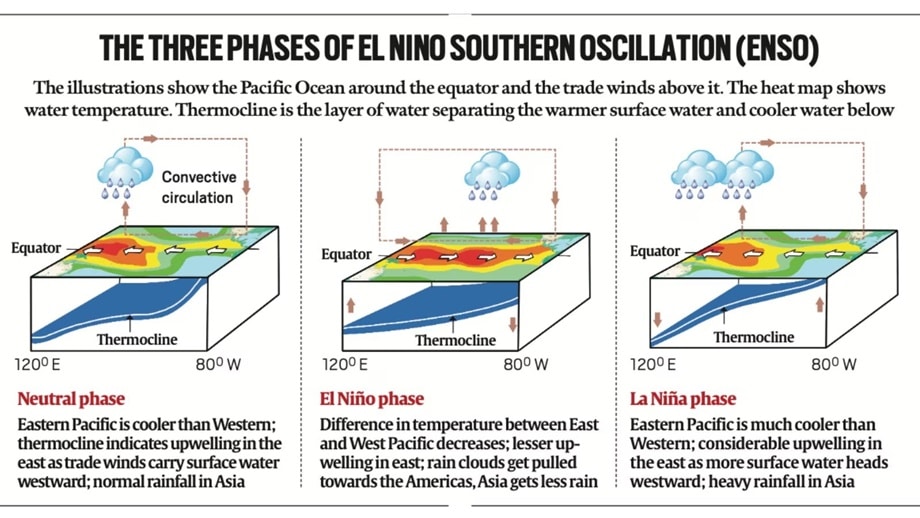 ENSO phases, explained.
Scientists measure the sea surface temperatures over specific regions of the equatorial Pacific Ocean.
Temperature anomalies in one of these regions, called the Nino 3.4 region, is usually the deciding factor in declaring the onset and strength of ENSO phases. Scientists calculate what is known as Relative Ocean Nino Index (RONI) from this region, essentially a temperature deviation from the normal. If the average RONI over a three-month period exceeds a value of 0.5 degrees Celsius, an El Niño is declared. An average RONI value less than -0.5 degrees Celsius leads to declaration of La Niña.
Story continues below this ad
The ongoing El Niño, experts say, has shown a rapid intensification. Since its emergence in June, the July-September RONI index recorded warming of 2 to 2.8 degrees Celsius.
These temperature values are set to break all records since ocean temperature monitoring began four decades ago. The previously recorded highest anomaly in the ocean temperatures was 3 degrees Celsius. The 2014-2015 El Niño peaked at 2.3 degrees Celsius, according to data maintained by the National Oceanic and Atmospheric Administration (NOAA).
But the current El Niño, dubbed as “godzilla” or super El Nino is set to surpass all previous temperature records. The WMO has said that the event is expected to peak during October-December.
“The temperature values at the epicentre of the El Niño in the Pacific Ocean are expected to remain 3.8 degrees Celsius above normal — a value that has never been recorded since the start of ocean temperature monitoring four decades ago. This El Nino will have far reaching consequences for several months ahead,” said WMO Secretary-General Celeste Saulo.
Story continues below this ad
Which regions will be affected by El Nino?
In the northern hemisphere, above-normal temperatures are likely over parts of southern Europe and Africa, the Arabian peninsula, the Indian subcontinent and eastern Asia. Above-normal rainfall will likely affect the Arabian peninsula, central and east Asia, coastal Southeast Asia and North America.
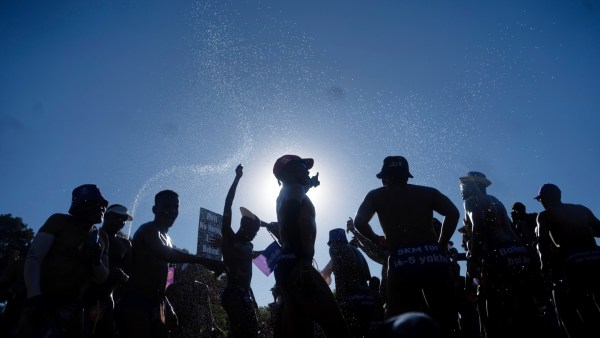 A hot day in Johannesburg on Friday. El Nino’s effect on Africa is expected to be particularly severe. (AP)
In the southern hemisphere, higher-than-normal temperatures are likely to sweep Africa, particularly the equatorial regions and the Greater Horn of Africa, along with South America and Australia. Unlike the northern hemisphere, many parts of the southern hemisphere are expected to see weak rainfall — over southern Africa, southern regions of Central America and the Caribbean.
Overall forecasts suggest that floods, droughts, extreme temperatures and cyclones could affect tens of thousands of people across the globe, particularly those living in Central and South America, southern Africa and Southeast Asia.
The effect on Africa is expected to be particularly severe. Some 50 million people could face increased hunger because of the weather phenomenon, said UN Humanitarian Affairs chief Tom Fletcher. The African Development Bank estimates that the El Nino will cost African countries between $10 and $20 billion and drag down GDP (gross domestic product) by 1-2%.
Story continues below this ad
El Niño could threaten food and water security, and push up fertiliser and fuel prices. These effects are likely to be felt well into 2027.
This will come as an additional burden on global resources, which are already under considerable strain owing to continuing conflicts, including the Strait of Hormuz crisis. “There is crisis upon crisis and all of that will push up prices of food, fuel and fertilizers,” warned Fletcher, who called upon countries and local governments to work with the UN.
Overall, the UN body handling humanitarian affairs has said that the Central and South American population needed to be provided with alternate livelihood options, the crops grown by the African communities and their seeds needed to be moved and stored to safer places before they are cut off. Southeast Asian countries, meanwhile, need to brace for floods, droughts and cyclones in the coming months.
(function(){var l=!1;function f(){if(l||window.fbq)return;l=!0;!function(n,t,e,f,o,c,i){if(n.fbq)return;o=n.fbq=function(){o.callMethod?o.callMethod.apply(o,arguments):o.queue.push(arguments)};n._fbq||(n._fbq=o);o.push=o;o.loaded=!0;o.version=”2.0″;o.queue=[];c=t.createElement(e);c.async=!0;c.src=f;i=t.getElementsByTagName(e)[0];i.parentNode.insertBefore(c,i)}(window,document,”script”,”https://connect.facebook.net/en_US/fbevents.js”);fbq(“init”,”444470064056909″);fbq(“set”,”autoConfig”,!1,”444470064056909″);setTimeout(function(){fbq(“track”,”PageView”)},500)}”requestIdleCallback”in window?requestIdleCallback(f,{timeout:3000}):setTimeout(f,2500)})();