
Saturn at opposition. Earth flies between the sun and Saturn on October 4, 2026. Our motion brings Saturn to its brightest and closest for the year. EarthSky’s Deborah Byrd wants to tell you how to see Saturn at opposition in the night sky … and more. Watch in the player above or on YouTube.
Saturn at opposition
When and where to watch: We fly between the sun and Saturn at around 7 a.m. CDT (12 UTC) on October 4. This is Saturn’s yearly opposition. So Saturn is visible all night — opposite the sun — now. It’s rising in the east as the sun is setting in the west. It’s highest in the sky in the middle of the night, when the sun is below our feet. And it’s in the west as the sun rises at dawn.
Brightness at opposition: Saturn is a bright planet. It’s as bright or brighter than the brightest stars. Still, it’s the faintest of the bright planets; it’s a bit inconspicuous in the night sky. That means its opposition month — when it’s a bit brighter than usual — is a great time to look for it. At this 2026 opposition, it’ll reach magnitude 0.3.
Distance from Earth at opposition: Outer planets are always closest to Earth at opposition. At the 2026 opposition, Saturn is approximately 784 million miles away. That’s about 1.26 billion kilometers. Or it’s 8.43 astronomical units (Earth-sun units). Or it’s about 70 light-minutes.
Constellation at opposition: Saturn will be in front of Cetus the Whale at the 2026 opposition.
Disk size at opposition: Saturn’s disk appears largest in size around opposition. That’s important to people looking through telescopes. At its largest, Saturn will appear through telescopes as 19.7 arcseconds across.
Ring tilt at opposition: We passed through the plane of Saturn’s rings in March 2025. That’s something we do every 13 to 15 years. The rings, which are exceedingly thin, can’t be seen in small amateur telescopes for a few weeks around the ring plane crossing. Now the rings are opening again. In October 2026, Saturn’s rings are tilted by -7.5 degrees south, relative to earthly viewers.
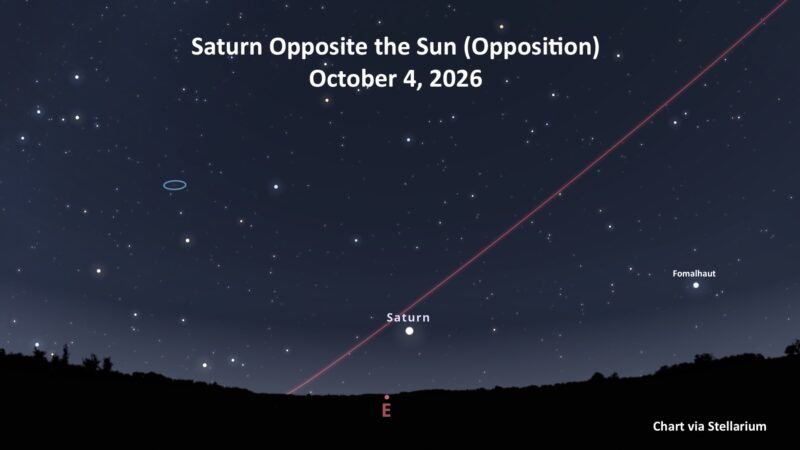

Around opposition is the best time to see Saturn
Opposition marks the middle of the best time of the year to see an outer planet. You can’t see Saturn’s rings through binoculars, but good binoculars, steadily held or mounted on a tripod, will reveal Saturn as a bright oval-shaped disk. Meanwhile, any small backyard telescope will show the rings.
Saturn’s rings: Top tips for seeing those glorious rings
For precise sun and Saturn rising times at your location:
Old Farmer’s Almanac (U.S. and Canada)
timeanddate.com (worldwide).
Stellarium-Web (online planetarium program)
In-the-sky information and finder chart from your location
View from above the solar system, October 2026
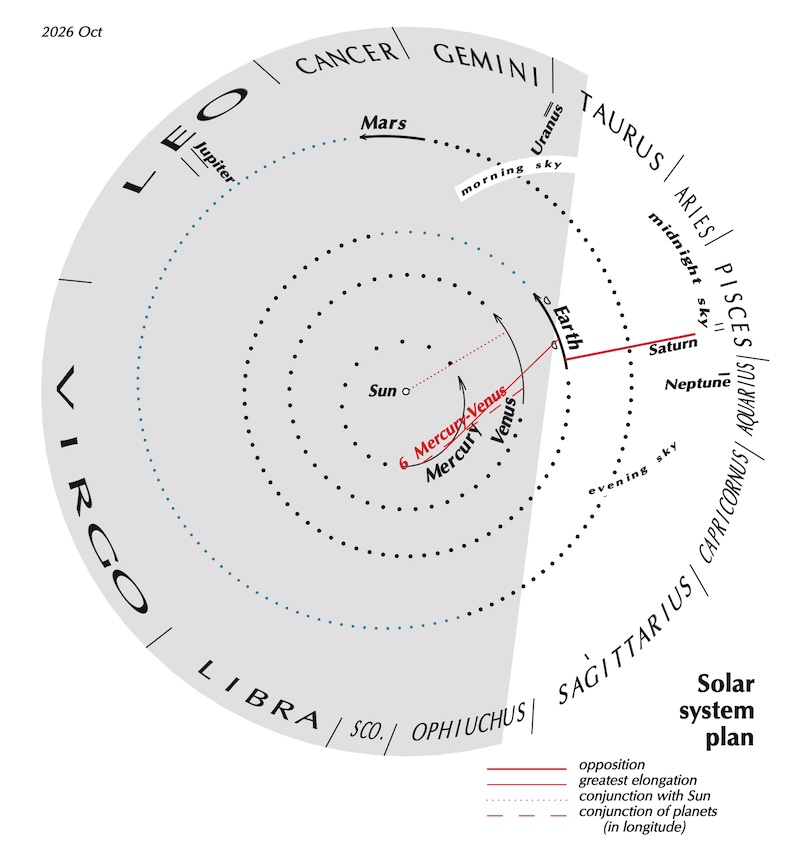
How often is Saturn at opposition?
In fact, Saturn comes to opposition nearly every earthly year. A year is the length of time Earth takes to travel once around the sun. But Saturn’s orbit around the sun takes 29.4 Earth years. So each year we have to travel slightly farther in orbit to catch up to, and pass, Saturn again. Thus Saturn oppositions are roughly 378 days apart and Saturn’s opposition comes about two weeks later each year.
Dates are based on UTC time.
2024 Saturn opposition: September 8
2025 Saturn opposition: September 21
2026 Saturn opposition: October 4
2027 Saturn at opposition: October 18
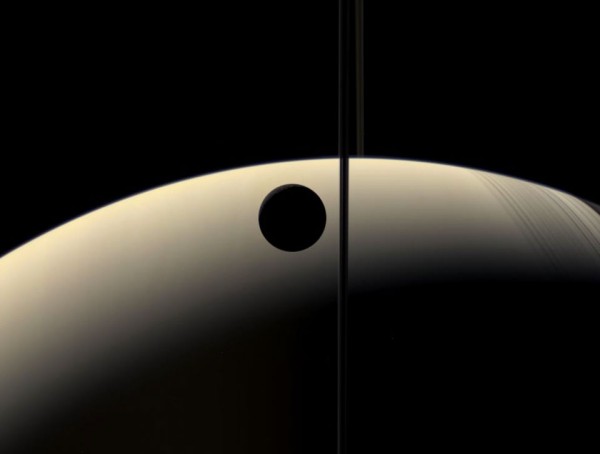
Saturn is a world of rings and moons
Saturn is the 6th planet outward from the sun. People in ancient times saw it as a golden “star” that moved among the fixed stars: a wanderer. It wasn’t until astronomers began using telescopes in the 17th century that they saw its rings.
Astronomers used to speak of Saturn as having three rings. But spacecraft in the later part of the 20th century showed vastly more detail. In fact, they revealed that Saturn has thousands of thin, finely detailed rings made of tiny chunks of ice. Also, Saturn has at least 293 moons with confirmed orbits. And many of them don’t have names. Furthermore, only 13 of them have diameters larger than 30 miles (about 50 kilometers).
Certainly, Saturn is truly a wondrous world of rings and moons. Usually, it’s everyone’s favorite celestial object to gaze at through a small telescope. So if there’s a public astronomy night near you this month … go!
Read more: Saturn’s rings are weird and wonderful: 10 facts here
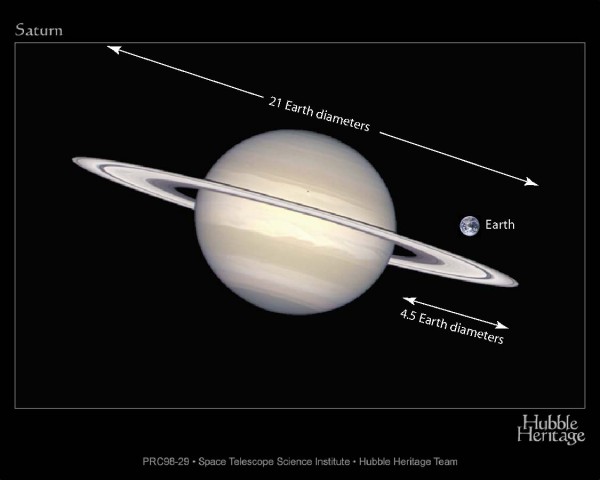
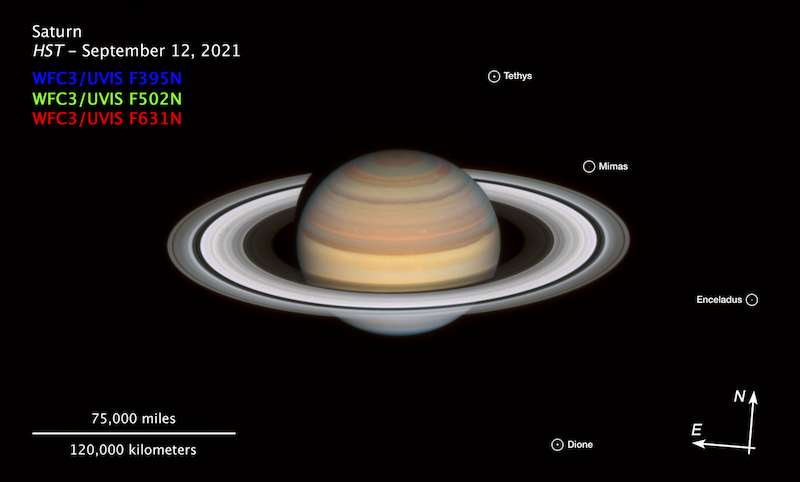
Saturn’s yearly changes

EarthSky community photos of Saturn
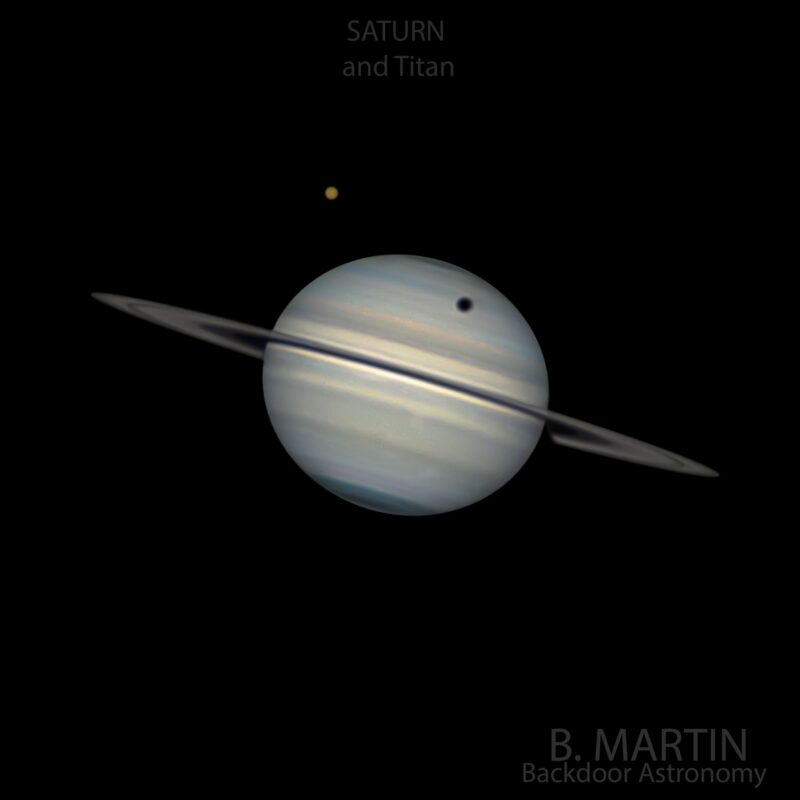
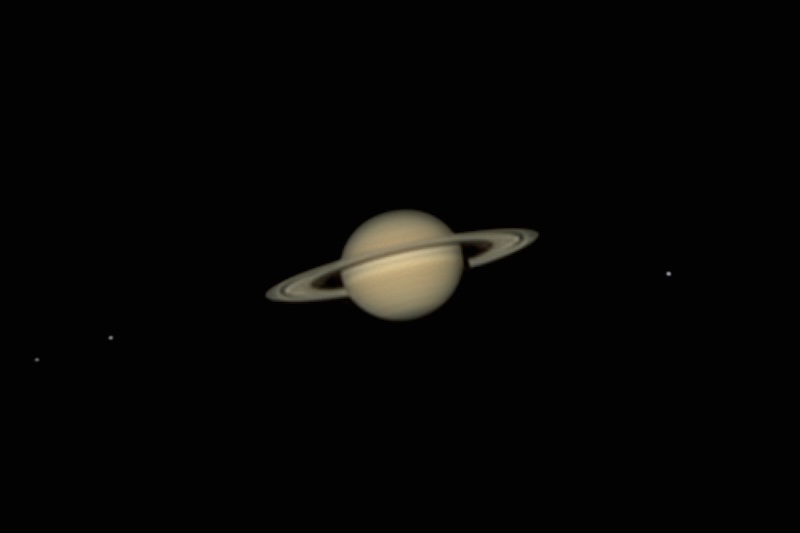
Bottom line: Saturn’s 2026 opposition comes on October 4, when Earth will sweep between the sun and Saturn, placing the ringed planet opposite the sun in our sky. Saturn will be in an excellent place to observe from late August through October.
Read more: What does opposition mean for an outer planet?
See also: Geocentric ephemeris for Saturn 2026
See also: Geocentric ephemeris for the sun: 2026